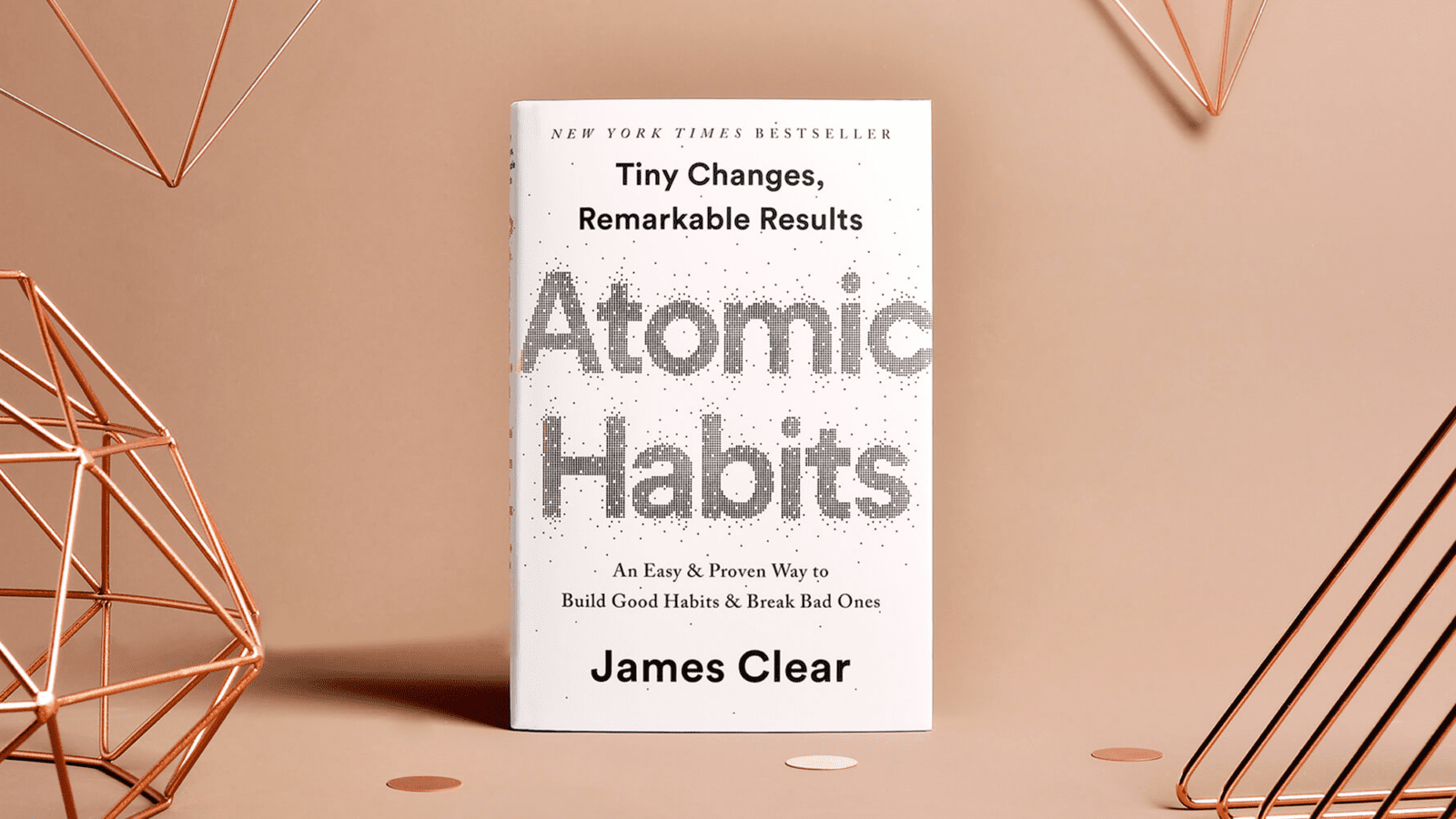
Atomic Habits (2018): why tiny changes beat heroic effort
James Clear’s Atomic Habits exists for a very specific kind of frustration: you know what you “should” do, you even feel motivated sometimes, but your life doesn’t reliably change. You make big plans, then reality returns—stress, schedules, fatigue, other people, old defaults. Clear’s promise is not a hypey transformation story. It’s a practical claim about how behaviour actually works: if you can get just a little better—small improvements that feel almost too small to matter—those changes compound into something that does matter.
The book is not really about willpower. It’s about design. Clear keeps returning to the same idea in different forms: if you want different outcomes, stop negotiating with yourself every day and build a system that makes the right behaviour the easiest behaviour.
Who James Clear is (and why his approach feels so usable)
Clear is best known for writing about habits, decision-making, and continuous improvement in a way that feels grounded rather than clinical. He’s a writer and speaker whose work has reached a wide audience largely because he translates behavioural science into everyday language and practical steps. That matters here because Atomic Habits isn’t trying to impress you with research references; it’s trying to help you run your life more deliberately.
The big idea in one sentence
Small habits don’t stay small—because their effects compound—so the smartest way to change your life is to change your daily system, one tiny behaviour at a time.
The problem the book is really addressing: identity drift
On the surface, people want “better habits.” Underneath, Clear is addressing a deeper pattern: we try to change by aiming at outcomes, while our day-to-day behaviour keeps reinforcing the same identity.
So we set goals like “get fit,” “write a book,” or “build a business,” but our actual routines keep casting votes for a different story: “I’m the kind of person who skips,” “I’m the kind of person who starts and stops,” “I’m the kind of person who waits until I feel ready.” Clear’s approach quietly shifts the target: instead of chasing the outcome, you build the identity—and you build the identity through repeated evidence.
How the book works: the Four Laws of Behaviour Change
Clear’s most practical contribution is a simple framework for shaping behaviour: make the good habit easier to start and the bad habit harder to continue. He frames this as four levers you can pull. These show up repeatedly throughout the book and act like a checklist for redesigning any habit.
In plain language, the four levers are:
- Make it obvious (design cues so the habit is hard to miss)
- Make it attractive (make the habit something you want to do, not only “should” do)
- Make it easy (reduce friction; lower the starting cost)
- Make it satisfying (make the payoff feel immediate enough to repeat) What makes this work is that it treats behaviour like something shaped by environment, emotion, and immediacy—not like a moral test.
Key ideas you can actually use (without turning it into a productivity religion)
Clear’s “atomic” framing is important: an atomic habit is small, but it’s also a unit of energy. It’s a repeatable action that carries force because it happens often. The goal is not intensity; it’s repeatability.
One of the most useful shifts in the book is the relationship between goals and systems. Clear doesn’t say goals are bad; he says goals are not where change lives. Goals set direction. Systems create progress. If you obsess over the finish line, you tend to ignore the daily process—or you treat the process as a temporary punishment until you “arrive.” But habits are not temporary. They are your life.
He also emphasises how much behaviour is friction-based. Most people think they fail because they lack discipline. Clear argues that, more often, they fail because the habit is inconvenient. If you want to read more, make the book visible and the phone less accessible. If you want to train, make the gym bag ready and the decision effortless. If you want to eat differently, shape what is easiest to reach for. This is “environment design” in practice.
Another quietly powerful idea is the role of immediate rewards. Good habits often pay off later; bad habits pay off now. Clear’s solution is not to lecture yourself; it’s to engineer some immediate satisfaction into the good habit so your brain has a reason to repeat it.
Finally, Clear keeps you oriented around identity: every repetition is a vote. You don’t become “a runner” by running once. You become a runner by proving it to yourself repeatedly, in small ways, until it becomes the default story you live from.
The stories (and why they stick)
Clear uses memorable examples to make abstract ideas feel concrete: the way tiny changes compound, how small environmental shifts can radically change behaviour, and how experts become experts by showing up consistently rather than by having one spectacular moment.
The lesson across the stories is consistent: if you focus on the input (the daily behaviour) and keep it small enough to be sustainable, the output (the results) will take care of itself.
Notes, critiques, and caveats
Because Atomic Habits is designed to be practical, some readers may want more scientific nuance or deeper engagement with competing research. Clear’s strength is translation, not academic debate.
Also, the book can be misused. If you treat habits as a way to optimise every moment, you’ll end up rigid and joyless. The healthier reading is: habits are a way to reduce chaos, protect what matters, and free your attention for better things.
And it’s worth saying plainly: not every problem is a habit problem. Trauma, depression, burnout, and systemic constraints can’t be solved by a better habit tracker. Clear’s tools help most when the constraint is behavioural design, not deep capacity.
Who should read this (and who shouldn’t)
Read this if you want a straightforward framework for building better routines without relying on motivation. It’s especially good for people who start strong and then fade, or who want to build consistency in creative work, health, leadership, or business.
If you’re looking for a dramatic reinvention narrative, or if you want a strict “one true morning routine,” this won’t give you that. It’s deliberately flexible.
Resources (Atomic Habits)
Who it’s for (and why it exists)
The workbook exists because insight is not behaviour. Many people read a book, highlight the key concepts, feel inspired… and then return to their default life. The workbook is built to close that gap. It’s for readers who want structure, prompts, and templates that make action harder to avoid and easier to repeat.
The big idea in one sentence
If habits change through small, repeated design choices, then guided exercises can help you make those choices deliberately—and keep making them long enough for them to stick.
How the workbook “works”
The companion format is built around doing, not consuming. Expect guided prompts, habit planning exercises, and reflective questions that help you:
- Choose a small habit that matters
- Identify the cue, craving, response, and reward driving your behaviour
- Reduce friction for the habit you want
- Increase friction for the habit you don’t
- Track progress in a way that reinforces consistency rather than perfection It’s also likely to be most useful when paired with a single focus. The workbook can’t do the work for you, but it can reduce indecision by giving you the next right question.
Notes, critiques, and caveats
If you already implement the Atomic Habits ideas easily on your own—building routines, tracking them, iterating weekly—the workbook may feel redundant.
But if you’re someone who understands concepts intellectually and still struggles to follow through, the structure and prompts can be exactly the missing piece.
Resources (Workbook)
- Official announcement (Penguin Random House)
- Author page: Atomic Habits Workbook
What to read next
Summary · 9 min read
The Art of Learning
An Inner Journey to Optimal Performance
Josh Waitzkin
- What it's about
- The Art of Learning was written to answer a difficult question: what carries across when someone becomes highly skilled in two very different fields? Josh Waitzkin first became famous as a child chess prodigy. Years later, after stepping…
- Why read it next
Josh Waitzkin, a chess prodigy turned Tai Chi Push Hands world champion, describes how mastery is actually built: small, deliberate refinements, learning from losses, and turning pressure into focus.
It is a natural next read because Atomic Habits gives you the system for repeating small actions, while The Art of Learning shows what those repetitions can become when they are aimed at genuine mastery.