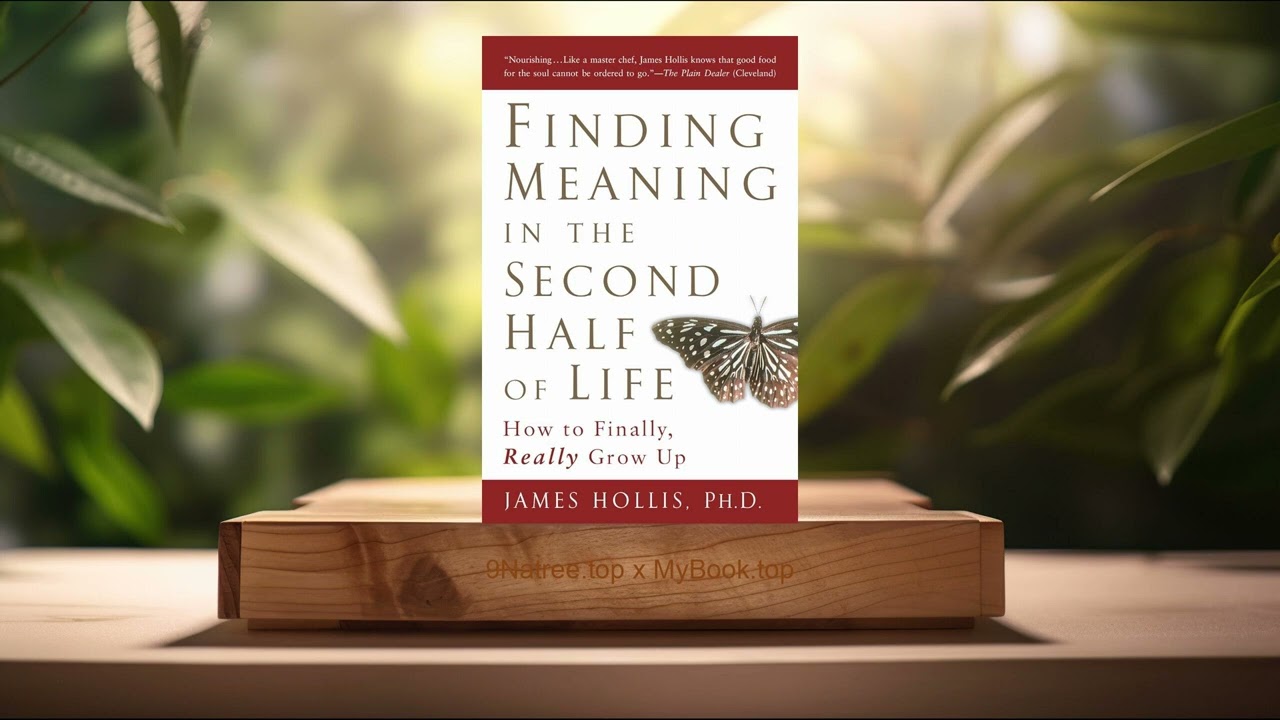
Why this book exists: midlife is not the problem — unconscious living is
Most people enter adulthood with a quiet bargain: if I do the right things, follow the right path, build the right career, choose the right partner, and become “responsible,” life will eventually settle into meaning. James Hollis wrote Finding Meaning in the Second Half of Life for the moment that bargain breaks. The outer life may still look functional, even successful, but something inside starts to ask different questions. Why am I doing this? Why does this no longer satisfy me? Who am I apart from the roles I have played?
The book is aimed at adults in midlife and beyond, but Hollis is careful not to reduce the “second half” to an age bracket. It can begin in your thirties, forties, fifties, or later. It begins when the strategies that helped you adapt to life no longer help you become fully alive. A career can lose its meaning. A marriage can shift. Children can leave home. A parent can die. Illness, disappointment, burnout, or a vague sense of emptiness can interrupt the story you were living inside.
Hollis’s deeper point is that this interruption is not merely a crisis to get through. It is an invitation to grow up in a more serious way. The first half of life is often about adaptation: learning how to survive, belong, achieve, and construct an identity. The second half asks for something harder and more honest: to recover personal authority, take responsibility for the life you are actually living, and develop a more mature relationship with meaning, mortality, love, work, and the soul.
Who James Hollis is, and why his voice matters
James Hollis is a Jungian analyst, teacher, and author. Before becoming an analyst, he spent many years as a humanities professor, which partly explains the texture of the book: it is psychological, but also literary, philosophical, and spiritual. He has written widely on adulthood, individuation, suffering, the shadow, and the search for meaning.
His Jungian background matters because the book is not a productivity guide, a career-change manual, or a happiness plan. Hollis is not mainly interested in helping you optimise your existing life. He is interested in helping you ask whether that life is still true. He works from the Jungian idea that human beings are not finished when they become socially functional adults. We keep developing. The psyche continues to press for wholeness, and if we ignore it, it often speaks through symptoms: anxiety, depression, compulsions, restlessness, relational conflict, resentment, or a growing sense that the old life has become too small.
That makes Hollis a demanding guide. He is compassionate, but not soft. He does not flatter the reader with easy reassurance. His comfort is of a different kind: the pain of midlife may not mean your life has failed; it may mean your deeper life is finally asking to be heard.
The thesis in one line
The second half of life becomes meaningful when we stop living mainly from inherited roles, old fears, and external approval, and begin taking conscious responsibility for the deeper summons of the self.
The deeper problem: the life you adapted to may not be the life you are meant to live
The book’s central tension is between adaptation and authenticity. In the first half of life, adaptation is necessary. Children need to survive their families, schools, cultures, religions, and social worlds. We learn what gets approval and what gets punished. We build a personality — what Jungians often call the persona — that helps us function. We become the good child, the achiever, the helper, the rebel, the rescuer, the expert, the strong one, the agreeable one.
This is not wrong. It is how we get into the world. But Hollis argues that what once protected us can later imprison us. The strategies that got us through childhood and early adulthood can become unconscious scripts. We choose work, relationships, and identities that feel “normal” not because they are deeply ours, but because they fit the expectations we internalised long ago.
Then the second half of life arrives and begins to expose the gap. The job that once delivered status may now feel hollow. The relationship that once provided safety may reveal dependency, projection, or avoidance. The faith tradition that once offered certainty may no longer hold the complexity of lived experience. The old ambitions may still be achievable, but no longer compelling.
For Hollis, this is where real adulthood begins. The question is no longer “How do I succeed inside the story I inherited?” The question becomes “What wants to live through me now, and what must I stop serving in order to answer it?”
How the book works: the passage from false self to personal authority
Hollis does not offer a neat seven-step framework. The book works more like a deep psychological map. It circles several core tasks that define the second half of life.
Recover personal authority
Personal authority is one of the book’s most important ideas. It means becoming answerable to the deeper truth of your own life, not merely to parents, partners, institutions, cultural scripts, or the need to be liked. Hollis is not promoting selfishness. He is arguing that many adults are still psychologically governed by old authorities: the father’s voice, the mother’s fear, the tribe’s rules, the school’s reward system, the church’s certainty, the marketplace’s definition of success.
Recovering personal authority means asking: whose life am I living? Who benefits from my obedience? What old fear is making this decision for me? What would I choose if I were no longer trying to earn permission?
This is painful because it often creates conflict. To become more honest, you may disappoint people who preferred the adapted version of you. But Hollis’s point is that a life built mainly on adaptation eventually becomes a form of self-abandonment.
Face the shadow
In Jungian psychology, the shadow is everything we have disowned, repressed, or refused to recognise in ourselves. It includes dark material — envy, rage, selfishness, fear, dependency — but also positive material we were taught to suppress: creativity, desire, courage, tenderness, ambition, authority.
The second half of life often forces the shadow into view. We may find ourselves reacting too strongly, repeating painful patterns, sabotaging intimacy, or feeling drawn to things that disturb our self-image. Hollis treats these moments not as evidence of failure, but as invitations to ask what part of the psyche is trying to be included.
The point is not to act out every impulse. It is to become conscious. What we refuse to know about ourselves tends to run us from below. What we can face, name, and integrate becomes part of a larger, more honest life.
Stop outsourcing meaning
A major theme in the book is that meaning cannot be handed to us by success, romance, children, work, religion, or social approval. These things can carry meaning, but they cannot bear the whole burden of giving us a life.
This is why Hollis is suspicious of the common midlife temptation to solve the crisis with external change alone: a new partner, new job, new body, new location, new achievement, new belief system. Sometimes external change is necessary. But if we do not address the inner pattern, we recreate the same problem in a new costume.
Meaning, in Hollis’s sense, is not the same as happiness. Happiness comes and goes. Meaning is the felt sense that one’s life is aligned with something deeper than comfort, approval, or habit. It often asks more of us, not less.
Accept suffering as information
Hollis does not romanticise suffering, but he does take it seriously. Pain, symptoms, dreams, grief, boredom, and anxiety may be signals that the old way of living has become too narrow. The task is not simply to eliminate discomfort as quickly as possible. The task is to ask what the discomfort is trying to reveal.
This is one of the book’s most countercultural ideas. Modern life often treats suffering as a technical malfunction: something to medicate, distract from, optimise away, or reframe into positivity. Hollis asks the reader to listen more deeply. What demand is the soul making? What truth has been avoided? What unlived life is pressing for attention?
Build a mature spirituality
Hollis’s spirituality is not necessarily religious, although religious readers may recognise much in it. He is talking about a larger orientation toward mystery, humility, mortality, responsibility, and the limits of ego control. A mature spirituality is not a set of easy answers. It is a way of standing honestly before life.
For Hollis, the second half of life strips away fantasies of control. We discover that achievement does not protect us from loss. Love does not protect us from loneliness. Intelligence does not protect us from unconsciousness. The task is to develop a relationship with life that can hold complexity without collapsing into cynicism or childish certainty.
Ideas you can actually use
Ask: “What is my life asking of me now?”
This is the central practical question of the book. Not “What do I want?” in the shallow consumer sense, and not “What will make others approve of me?” but “What is life asking of me now?” It shifts the focus from preference to vocation — from comfort to responsibility.
Notice where your old strategies no longer work
Many midlife struggles are not random. They are signs that an earlier survival strategy has reached its expiry date. Overwork may once have earned safety or approval. Pleasing others may once have prevented conflict. Emotional distance may once have protected you. But the second half of life asks whether these strategies now cost more than they give.
Track your symptoms as messages
Hollis encourages a more curious relationship with distress. Anxiety, depression, resentment, envy, and compulsive behaviour may be clues to a conflict between the life you are living and the life seeking expression. This does not mean ignoring clinical help. It means treating symptoms not only as problems, but as communications.
Withdraw projections from other people
A lot of adult suffering comes from asking other people to carry parts of our inner life. We expect partners to complete us, bosses to validate us, children to redeem us, institutions to give us identity. Hollis’s work asks us to take those projections back. The people we love become freer when they no longer have to rescue us from ourselves.
Choose meaning over comfort
The second half of life is not about becoming more comfortable. It is about becoming more truthful. Sometimes the meaningful choice is inconvenient, unpopular, or frightening. Hollis repeatedly pushes the reader toward a braver question: not “Will this make me happy right now?” but “Will this enlarge or diminish my soul?”
The stories and images that carry the book
The book’s “stories” are less like case studies and more like recurring images of adult life.
The first is the image of the successful adult who discovers that success has not saved them. This person has done what they were supposed to do — career, marriage, children, achievement, respectability — and yet feels strangely empty. Hollis uses this as the doorway into the second half of life: the collapse of the old promise that external structure alone can provide inner meaning.
The second is the image of the child within the adult. Much of what we call personality is shaped by early wounds and adaptations. The adult may have power, money, status, and competence, but still be governed by an anxious child seeking safety or approval. The work of the second half is to stop letting that younger part secretly run the life.
The third is the encounter with mortality. Ageing, illness, loss, and death are not side themes in the book; they are teachers. Mortality clarifies. It asks whether the life you are living is worth the finite time it consumes. Hollis’s point is not morbid. It is liberating: death makes the question of meaning urgent.
The fourth is the idea of the summons. The deeper self does not usually speak in neat plans. It speaks through longing, disturbance, dreams, symptoms, grief, and repeated patterns. The second half of life begins when we stop treating those signals as interruptions and start treating them as invitations.
Notes, critiques, and caveats
The book’s greatest strength is also its main limitation: it is deep rather than simple. Hollis writes in a reflective, literary, Jungian style. Readers looking for a crisp model, exercises, worksheets, or tactical steps may find it too abstract. It gives you questions more than answers. For the right reader, that is exactly the point. For the wrong moment, it may feel heavy or elusive.
A second critique is that the book can feel psychologically intense. Hollis takes suffering, shadow, mortality, and inner conflict seriously. That can be refreshing if you are tired of shallow self-help, but it may feel bleak if you are looking for hope in a lighter form. The hope is there, but it is hard-won. Hollis does not sell optimism; he offers depth.
A third caveat is that the book’s emphasis on inner authority can be misread as individualism. Hollis is not saying relationships, duties, family, community, or tradition do not matter. He is saying they become healthier when we relate to them consciously rather than through fear, dependency, or inherited obligation. Still, readers in highly constrained social, financial, or family situations may need to translate his ideas carefully. Not every life can be remade quickly from the inside out.
A fourth critique comes from outside the Jungian tradition. Some readers may question the language of soul, psyche, dreams, and individuation, especially if they prefer evidence-based psychology. Hollis’s work is not written like academic behavioural science. It is closer to depth psychology and philosophical reflection. Its value lies less in measurable protocols and more in its power to help readers recognise the hidden patterns shaping their lives.
Finally, the book can provoke more questions than it resolves. That is not a defect, but it matters. This is not a book to “finish” and implement by Friday. It is the kind of book that works on you slowly. It may be better read in small portions, with journaling, conversation, therapy, coaching, or long walks alongside it.
Who this is for (and who should pass)
Read this if you are in a season where the life that once made sense no longer feels sufficient. It is especially useful if you are facing midlife questions around work, marriage, parenting, faith, ageing, loss, burnout, or the feeling that you have become overly adapted to other people’s expectations.
It is also a strong read for coaches, therapists, leaders, and anyone doing people-development work, because it gives language for a kind of adult growth that is deeper than skills and performance. Hollis helps explain why people can be outwardly competent and inwardly stuck — and why real development often begins when old identities stop working.
You may want to pass, or wait, if you need a practical career-change guide, a light motivational book, or a step-by-step plan. This book is more mirror than map. It will not tell you exactly what to do next. It will make it harder to avoid the questions you already know are waiting.
Where to go deeper
What to read next

Summary · 10 min read
The Art of Possibility
Transforming Professional and Personal Life
Rosamund Stone Zander; Benjamin Zander
- What it's about
- Most people spend their days inside a world of measurement — comparing, competing, worrying about whether they're good enough, keeping score against everyone around them. The Art of Possibility was written for people who feel stuck inside…
- Why read it next
Benjamin Zander and Rosamund Stone Zander argue that much of what traps us is not reality itself, but the frame through which we interpret reality. Their book offers a warmer, more practice-oriented companion to Hollis: where Hollis asks you to face the deeper summons of the self, the Zanders help you experiment with new frames that open possibility in daily life.
It is a good next read because Finding Meaning in the Second Half of Life can feel heavy and inward, while The Art of Possibility helps translate inner freedom into a more generous, creative way of engaging work, relationships, and leadership.