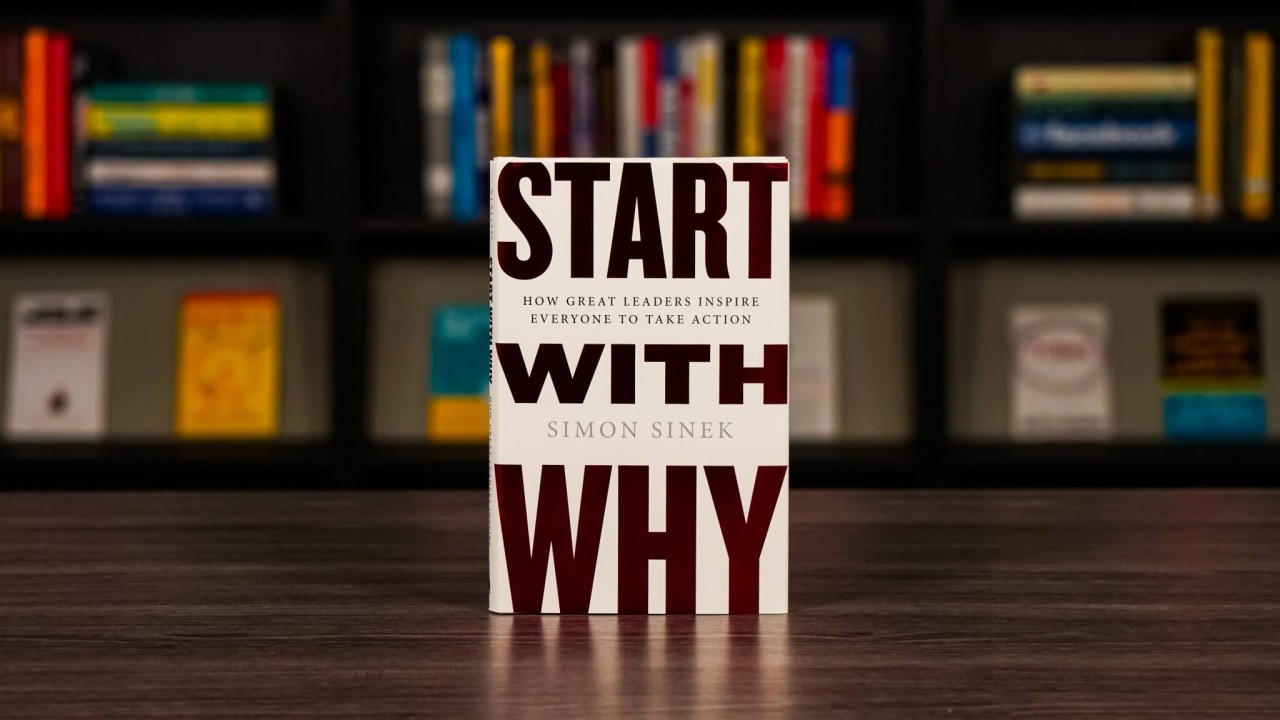
Why this book exists: leadership got reduced to tactics
Simon Sinek wrote Start with Why to push back on a pattern he kept seeing in business: organisations obsess over what they do and how they do it, but struggle to explain why they exist in a way that actually moves people.
When you don’t have that deeper clarity, you can still hit targets for a while. You can discount your way to sales. You can pressure people into performance. You can copy other companies’ “best practices.” But the energy never lasts. Loyalty is fragile. Culture becomes transactional. And the work starts to feel like a machine that only runs when someone is pushing it.
The book’s promise is simple: the leaders and organisations that inspire and endure tend to communicate from the inside out. They start with a purpose, cause, or belief (the why), then express it through the way they operate (the how), and only then through the products and results (the what).
Who Simon Sinek is (and why his message travelled)
Sinek is a writer and speaker best known for translating ideas about leadership and organisational purpose into language that feels memorable and usable. Start with Why became widely known because it connects a practical business problem (how to build loyalty and inspire action) with a simple visual model (the Golden Circle) and a persuasive set of stories.
His credibility in this book is less “academic proof” and more “pattern argument”: he’s trying to show a repeatable logic across very different examples (social movements, innovation, business) and give leaders a framework for communication and culture.
The thesis, in one sentence
The most influential leaders and organisations succeed over the long term because they start with a clear why, communicate it consistently, and build everything else around it.
The deeper problem: when you lead with what, you end up relying on manipulation
Under the surface, Sinek is not really writing about branding. He’s writing about trust.
If people don’t feel connected to what you believe, they’ll still buy from you or work for you—but usually for shallow reasons: price, convenience, fear, status, pressure, novelty, or perks. Those levers “work,” but they don’t create devotion. They create compliance.
Sinek’s claim is that manipulation is expensive. It requires constant incentives and constant energy. Inspiration is cheaper over time because it builds voluntary commitment: people choose you even when they have alternatives.
This is why the book spends so much time on loyalty. The real question is not “How do we get people to buy?” It’s “How do we build something people want to be part of?”
The Golden Circle: the core framework (and what it changes)
Sinek’s main model is the Golden Circle:
- Why: the purpose, cause, or belief (why you exist)
- How: the principles and distinctive ways you bring the why to life
- What: the products, services, and results you create Most organisations communicate outside-in (what → how → why). Sinek argues that inspiring leaders communicate inside-out (why → how → what).
The point is not that your “why” is a slogan. It’s a belief that shapes behaviour. If the why is real, it becomes a filter for decisions: who you hire, what you build, what you say no to, and how you show up when it’s costly.
The “why” is not profit
A useful line in this framework is that profit is a result, not a why. A why is meant to describe the contribution you’re trying to make and the world you’re trying to build.
You don’t have to be a charity. But if money is the only story, you’ll struggle to create loyalty that survives hard seasons.
Clarity, discipline, and consistency
Sinek also suggests three practical qualities that separate organisations that keep their why intact from those that drift:
- Clarity: you can explain what you believe in plain language
- Discipline: you align systems and decisions to that belief
- Consistency: people experience the same belief over time, across touchpoints These are not motivational ideas; they’re operational. When the why is clear, it becomes easier to choose a direction. When discipline is present, the why becomes visible in behaviour. When consistency exists, trust accumulates.
Practical ideas you can actually use
The easiest way to apply this book is to treat the Golden Circle as a communication and decision tool.
Rebuild your message from the inside out
Instead of starting with features or credentials, start with belief:
- What do we believe?
- What are we trying to change?
- Why should anyone care? Then connect it to how you behave differently, and only then to what you make.
Done well, this doesn’t sound like marketing. It sounds like meaning.
Use “why” as a decision filter
A real why is useful when it costs something.
If a decision would help short-term results but undermines what you claim to believe, the why gives you a reason to say no. Without that filter, you drift. And drift is what slowly breaks trust.
Hire and lead for belief-alignment, not just skill
Sinek argues that the people who thrive in a culture are usually people who resonate with its belief system. Skills matter, but belief creates coherence.
That doesn’t mean hiring clones. It means being honest about what you’re building, so the people who join are joining the actual mission, not an imagined version of it.
Beware of “why-washing” (your own and everyone else’s)
The biggest trap is to turn “why” into a poster.
If the organisation’s behaviours (especially under pressure) contradict the stated why, the result is cynicism. In that sense, a why makes you more accountable: once you say what you believe, people will watch whether you live it.
The stories that teach the framework (and the lesson)
Sinek relies heavily on a small set of repeated examples. Whether you find them persuasive or not, the function of the stories is consistent: to show what inside-out leadership looks like.
Apple: leading with belief, not product specs
Apple is used to show how a why-led message changes how people interpret the what.
The lesson is not “copy Apple’s marketing.” It’s: when you start with a belief (“we challenge the status quo”), the products become proof of that belief instead of the main event.
Martin Luther King Jr.: people join a cause, not a plan
Sinek uses King to show that movements are built through a clear articulation of belief and a shared picture of a better future.
The lesson: inspiring leaders don’t just describe tasks. They describe meaning, and people opt in because they want to belong to that meaning.
The Wright Brothers: you can beat resources
The Wright Brothers appear as an example of mission-driven obsession outperforming better-funded competitors.
The lesson: when the why is strong, it generates persistence and creativity that can outperform sheer resources—especially in the early, uncertain stage.
Notes, critiques, and caveats
This book is powerful as a lens, but it has real limitations.
A common critique is that the argument is not rigorously proven. Many examples are anecdotal, and correlation is sometimes treated as causation. The framework can also feel circular: if an organisation is inspiring, we infer it must have a strong why; if it has a strong why, we predict it will be inspiring.
Another critique is that “why” is not sufficient. Purpose without competence becomes theatre. You still need the how (execution, systems, strategy) and the what (real value delivered). Some critics argue Sinek underplays this, or that the idea could be communicated in far fewer pages.
A more practical caveat is that a why can be misused. Leaders can weaponise “purpose” as a way to demand sacrifice, avoid accountability, or pressure people into alignment. A healthy why is paired with honesty, fair incentives, and real care for people.
The best way to read the book is as a starting discipline: a framework for clarity and consistency—not a magic formula.
Who should read this (and who shouldn’t)
Read this if you lead a team, brand, or organisation and you can feel the limits of purely tactical leadership. It’s especially helpful if your message has become feature-heavy, your culture has become compliance-driven, or your work has started to feel like “busy without belief.”
Skip it (or just start with the TED talk) if you need tight evidence, academic depth, or a step-by-step operational playbook. The value here is the model and the lens, not a rigorous proof.
Resources (credible links)
What to read next
Summary · 5 min read
Dare To Lead
Brené Brown
- What it's about
- Dare to Lead exists because many organisations say they want “leaders,” but reward self-protection: pretending to know, avoiding hard conversations, managing perception, and staying safe. Brené Brown argues that this creates cultures of…
- Why read it next
Brené Brown’s Dare to Lead is a practical next step because it translates “inspiration” into day-to-day leadership behaviour: trust-building, values, hard conversations, and courage when things get messy.
If Start with Why helps you name what you believe and communicate it clearly, Dare to Lead helps you build the kind of culture where that belief is actually lived—especially under pressure.