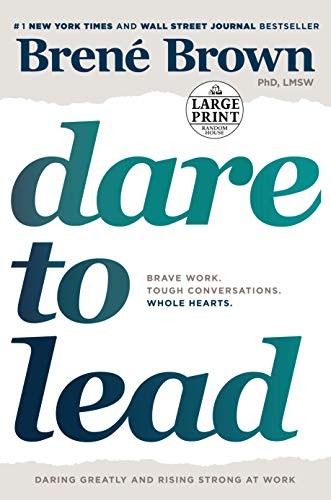
What this book is trying to fix
Dare to Lead exists because many organisations say they want “leaders,” but reward self-protection: pretending to know, avoiding hard conversations, managing perception, and staying safe. Brené Brown argues that this creates cultures of fear and scarcity — and it quietly kills learning, trust, and innovation.
This is a book for people who lead teams (or want to), and who know that the hardest part of leadership is not strategy. It’s courage in human moments: feedback, conflict, accountability, failure, and uncertainty.
Why Brené Brown’s voice is credible here
Brown is a research professor known for studying shame, vulnerability, courage, and belonging. She translates social science into language leaders can use. Her work stands out because it doesn’t romanticise vulnerability. It operationalises it: what it looks like in meetings, in feedback, and in cultures under pressure.
The thesis in one sentence
Daring leadership is the practice of showing up with courage and clarity — choosing vulnerability, values, trust, and learning over self-protection.
The deeper problem: armored leadership
Brown says most people lead with armor. Armor is the behavior you use to avoid discomfort: being right, being busy, being liked, being certain, being “the expert.” It looks professional, but it blocks the very things leadership needs: honest information, ownership, and connection.
When leaders model armor, teams copy it. People stop telling the truth. They stop taking risks. They start managing optics. In that environment, the organization becomes fragile.
The core framework: the four skill sets of daring leadership
Brown frames daring leadership as learnable skills, not personality traits. The four skill sets are:
- Rumbling with vulnerability: staying present in hard conversations instead of tapping out, blaming, or performing.
- Living into our values: turning values from posters into behaviors and boundaries.
- Braving trust: building and repairing trust through small actions.
- Learning to rise: building resilience after failure, disappointment, or criticism. The point is simple: courage is not a motivational quote. It is a set of practices.
Rumbling: how hard conversations actually work
A “rumble” is a conversation where you choose curiosity and honesty over winning.
Brown emphasizes a few practical moves:
- Name the story you’re telling yourself. This exposes assumptions before they harden into certainty.
- Get specific. “You’re not committed” becomes “You missed two deadlines; what happened?”
- Stay in the discomfort. Avoiding discomfort doesn’t remove it — it just moves it into politics and resentment. Rumbling is not softness. It’s disciplined clarity.
Values: turning ideals into behavior
Brown makes a sharp distinction between “values” and “virtues.” Many people list ten values, which usually means none of them guide behavior.
Her advice: pick your top two values and define what they look like when you are:
- under pressure
- tired
- afraid
- tempted to avoid a conversation Values become real when they create boundaries. If “respect” is a value, what behavior is not allowed? What behavior must be done even when it’s awkward?
Trust: BRAVING
One of the most useful parts of the book is the BRAVING acronym. It breaks trust into behaviors you can actually practice:
- Boundaries: I respect yours and keep mine.
- Reliability: I do what I say I’ll do.
- Accountability: I own my mistakes and make amends.
- Vault: I don’t share what isn’t mine to share.
- Integrity: I choose courage over comfort; values over convenience.
- Nonjudgment: You can ask for help without being shamed.
- Generosity: I assume the most generous interpretation I can, before I react. This matters because most trust breakdowns are not dramatic betrayals. They are small leaks repeated.
Learning to rise: resilience after failure
Brown argues that leaders have to normalize learning and failure without turning everything into “growth mindset” slogans.
Rising has a rough shape:
- Reckoning: you notice what you are feeling (emotionally and physically).
- Rumble: you interrogate the story you’re telling yourself and seek what’s true.
- Revolution: you integrate the lesson and change behavior. Resilience is not “bounce back fast.” It is “learn honestly and come back wiser.”
Essential narratives (and the lesson)
The recurring story is cultural: teams are not lacking talent; they are lacking psychological safety and trust.
Brown’s most consistent lesson: the biggest barrier to courageous leadership is not other people. It’s the leader’s fear of discomfort and loss of control. When leaders do the work, cultures shift.
Notes, critiques, and caveats
- Some readers find Brown’s style repetitive. The repetition is partly intentional — it’s teaching, not just describing.
- The book assumes leaders have enough autonomy to change how they lead. In highly constrained environments, you may need to focus on “micro-courage” first (one conversation, one boundary).
- The framework is strong, but implementation takes practice; it’s not a one-week transformation.
Who this book is for (and who it isn’t)
Read it if you:
-
Lead people and want concrete language for courage, trust, and feedback
-
Want to build cultures where people can tell the truth
-
Want a leadership model that is both humane and demanding Skip it if you:
-
Want tactics without inner work
-
Prefer a purely strategic leadership book with minimal emotional content
Resources
What to read next

Summary · 10 min read
Supercommunicators
How to Unlock the Secret Language of Connection
Charles Duhigg
- What it's about
- Charles Duhigg wrote Supercommunicators because he kept running into the same private frustration that most of us recognise: he could be articulate, well-prepared, and well-intentioned, and still walk out of important conversations — with…
- Why read it next
Charles Duhigg shows that every conversation is really one of three kinds — practical, emotional or social — and that the best communicators notice which one they are in and match it.
It is a natural next read because Dare to Lead asks you to stay in the hard conversations, and Supercommunicators gives you the practical skills to make those conversations land.