
Why this book exists
Most of us are trained to solve problems by breaking them into parts. That works well when the parts are mostly independent. It works badly when they form a living system: a company, team, market, city, family, body, ecosystem, or economy.
In a system, causes and effects circle back on each other. Results arrive late. A sensible action in one place can create a serious problem somewhere else. The same well-intended fix can even make the original problem worse.
Thinking in Systems: A Primer was written to make systems thinking useful outside specialist modelling circles. Meadows wanted readers to see why complex problems resist quick fixes, recognise the structures producing repeated behaviour, and find better places to intervene. The book is for leaders, policymakers, designers, managers, citizens, and anyone frustrated by problems that keep returning after they have supposedly been solved.
Published by Chelsea Green in 2008 and edited by Diana Wright, it grew from a manuscript Meadows drafted in 1993. It sits across systems science, organisational learning, public policy, sustainability, and practical problem-solving.
The thinker behind the systems lens
Donella “Dana” Meadows was a scientist, teacher, farmer, and one of the twentieth century’s most influential systems analysts. She earned a PhD in biophysics from Harvard and later joined the MIT group that applied system dynamics to large social and environmental questions.
She was the lead author of The Limits to Growth, the landmark 1972 study that used computer models to explore what could happen when population and economic activity keep expanding on a finite planet. She later taught at Dartmouth College, received a MacArthur Fellowship, and founded the Sustainability Institute.
That background matters because this book is not abstract theory from a distance. It distils roughly thirty years of modelling, teaching, and practical work. Meadows is interested in analysis only when it helps people deal with real problems. Diana Wright completed and structured the manuscript after Meadows died in 2001, preserving its unusually warm mix of technical clarity, humility, and moral seriousness.
The big idea in one sentence
A system’s behaviour comes mainly from the relationships, feedback loops, delays, rules, goals, and beliefs built into its structure—so lasting change requires understanding and changing that structure, not merely reacting to events.
Why obvious solutions keep failing
The book’s deeper target is event-level thinking. Something happens, we identify the nearest visible cause, and we act on it. Sales fall, so we push harder. A team misses targets, so we tighten control. Traffic increases, so we build more roads. A harmful behaviour appears, so we punish it.
These responses often overlook the structure that keeps generating the behaviour. A new road can make driving easier, which encourages more driving, which fills the road again. Tighter control can reduce initiative, which creates more mistakes and invites even tighter control. A short-term fix can weaken the system’s ability to solve the problem for itself.
Meadows asks us to move through three levels of attention: from events, to patterns over time, to the system structure producing those patterns. The goal is not to ignore individual responsibility or outside shocks. It is to stop mistaking a trigger for the whole explanation.
This shift is uncomfortable because it removes the comfort of simple blame. It also creates agency. If recurring outcomes are shaped by structure, different structures can produce different outcomes.
How a system actually works
A system has three basic elements: parts, connections, and a function or purpose. A football team is more than its players. Its roles, information flows, incentives, habits, and shared purpose shape how it behaves. Change the players without changing those relationships and the old pattern may return.
Stocks and flows
A stock is something that accumulates over time: cash, inventory, trust, skill, population, water in a reservoir, or work waiting in a queue. A flow changes the stock: revenue and spending, hiring and departures, learning and forgetting, arrivals and completed work.
The bathtub is Meadows’s simplest picture. Water in the tub is the stock. The tap is the inflow and the drain is the outflow. To understand the water level, you must look at both flows and how they change over time.
Stocks create stability because they act as buffers. They also create delay. A company can look healthy while its pipeline is quietly emptying. Trust may take years to build and only become visibly depleted after many small withdrawals.
Feedback loops
A balancing loop tries to move a system towards a target. A thermostat compares the current temperature with the desired one and switches heating on or off. Good balancing loops depend on accurate information, sensible goals, and timely action.
A reinforcing loop amplifies change. Interest earns interest. Practice builds skill, which makes practice more rewarding. Reputation attracts opportunity, which strengthens reputation. Reinforcing loops can create growth, decline, inequality, panic, or momentum.
Most real systems contain both kinds. Growth may be driven by reinforcing loops while resources, capacity, or demand create balancing limits. The behaviour we see comes from which loops dominate at a particular time.
Delays, nonlinearities, and boundaries
Information, decisions, and physical changes rarely move instantly. Delays can make a system oscillate because people keep correcting after the effect of an earlier correction is already on its way. This is why supply chains over-order, managers overreact, and policies are abandoned before they have had time to work.
Systems are also nonlinear: twice the input does not always produce twice the result. A small change may do almost nothing until a threshold is crossed, after which the system shifts quickly.
Finally, every system boundary is a choice. Draw it too narrowly and you miss important causes. Draw it too widely and the model becomes unusable. A good boundary includes enough of the surrounding system to answer the question at hand.
The patterns that keep repeating
Meadows describes common “system traps”—structures that appear in businesses, relationships, communities, and public policy.
- Policy resistance: Different actors pull the system towards different goals, so their efforts cancel one another. The opportunity is to stop pushing harder and align around a larger shared goal.
- The tragedy of the commons: Each actor benefits from using a shared resource, while the cost is spread across everyone. The answer usually needs clear rules, trusted information, and shared responsibility.
- Drift to low performance: Poor results lower expectations, and lower expectations make further decline acceptable. Hold the standard steady and use the gap as information.
- Escalation: Two actors measure success against each other, creating an arms race. Change the goal, refuse the contest, or build a cooperative arrangement.
- Success to the successful: Early winners receive more resources and therefore keep winning. Diversify support and design the rules so one advantage does not become permanent domination.
- Shifting the burden: A quick external fix reduces the pressure to build internal capacity. Over time, dependence grows. Use relief carefully while strengthening the system’s own ability to respond.
- Rule beating: People satisfy the letter of a rule while defeating its purpose. Treat gaming as feedback about poor rule design, not only as misconduct.
- Seeking the wrong goal: The system delivers what is measured, even when the measure is a weak proxy for what matters. Choose indicators that reflect the real purpose. These patterns are useful because they help you recognise structure faster. They are not labels to force onto every situation. A pattern is a starting hypothesis, not a complete diagnosis.
Where change has the most leverage
One of the book’s best-known ideas is its list of leverage points: places where an intervention can change a system. Meadows ranks them roughly from shallow to deep. The list is best read as a challenge to instinct, not a mechanical recipe.
From lower to higher leverage:
- Parameters: Change numbers such as budgets, targets, taxes, prices, or standards.
- Buffers: Change the size of stabilising stocks relative to their flows.
- Physical structure: Redesign networks, pipelines, capacity, and other material flows.
- Delays: Change how quickly information or action moves through the system.
- Balancing loops: Strengthen the system’s ability to correct unwanted drift.
- Reinforcing loops: Slow harmful compounding or support beneficial momentum.
- Information flows: Give the right people timely visibility of what is happening.
- Rules: Change incentives, constraints, permissions, and accountability.
- Self-organisation: Increase the system’s capacity to learn, experiment, and create new structures.
- Goals: Change what the system is organised to achieve.
- Paradigms: Change the beliefs and assumptions from which the goals and rules arise.
- Transcending paradigms: Hold any worldview lightly enough to notice when it no longer fits. The practical lesson is that visible numbers are easy to adjust but often have limited effect. Rules, goals, information, and underlying beliefs are harder to change, yet they can reshape many parts of the system at once.
This does not mean a deeper intervention is always better. A small parameter change can matter enormously near a threshold, and changing a paradigm carelessly can destabilise the whole system. Leverage is powerful precisely because the consequences can be large and surprising.
How to use the book in real work
Start by naming the behaviour over time, not just the latest event. Ask: What pattern keeps repeating? A simple graph is often more useful than a long explanation.
Then identify the important stocks. What is accumulating or being depleted? In a team, this may be trust, capability, unresolved work, or fatigue. Map the inflows and outflows that change those stocks.
Next, look for feedback. What becomes easier or harder as the stock changes? Which loops reinforce growth or decline? Which loops are supposed to keep the system stable? Where are delays hiding the effect of decisions?
After that, ask what the system is truly optimising. Do not rely on the stated mission. Look at what behaviour is rewarded, what information is visible, where resources go, and which outcomes trigger attention. The behaviour of the system often reveals its real goal more clearly than its language does.
Before intervening, test several explanations. Listen to people in different positions because each person sees only part of the system. Make the smallest safe experiment that can teach you something. Watch for delayed and unintended effects. Keep updating the model.
Most importantly, replace the fantasy of control with the practice of learning. Meadows does not promise perfect prediction. She argues for better observation, better questions, more humility, and a willingness to adapt.
The stories that make the ideas stick
The Slinky
Meadows holds up a Slinky and removes the hand supporting it. It bounces; a cardboard box held the same way does not. The hand triggered the movement, but the Slinky’s structure produced the behaviour. The lesson is that outside events matter, yet a system’s response depends on what it is.
The bathtub
A bathtub fills according to the relationship between the tap and the drain. Looking only at the water level—or only at the tap—creates mistakes. The story teaches the foundation of stock-and-flow thinking: current conditions are accumulated history, and change depends on rates moving in and out.
The thermostat
A thermostat measures a gap between the actual and desired temperature, then acts to close it. This simple balancing loop shows how goals, information, and corrective action work together. If the information is late or the response too strong, even a well-designed loop can overshoot and oscillate.
The fishery
A fish population, fishing effort, regeneration, and profit interact in nonlinear ways. More boats may raise the catch for a time, but falling fish stocks eventually reduce productivity and can push the whole system towards collapse. The story shows why maximising a visible flow can destroy the stock that makes the flow possible.
What the book gets right—and where to be careful
The strongest criticism is also one Meadows makes herself: every model is incomplete. The book uses the language of system dynamics, one school within a much larger field. Its clean diagrams help readers see feedback, but they can tempt us to treat a map as the territory. Qualitative knowledge, history, culture, and lived experience may not fit neatly into arrows and loops.
A second caveat is that identifying a leverage point is easier than changing it. Later systemic-design and sustainability research has argued that Meadows’s influential hierarchy is still more of a powerful typology than a complete theory of how change happens. Real interventions depend on timing, context, coalitions, capability, and how several leverage points interact.
Third, social systems contain power. People do not merely hold different information; they have unequal authority, resources, and exposure to risk. A technically elegant intervention can fail when it ignores whose interests are protected, who pays the cost, and who gets to define the system’s goal. Systems thinking should deepen political and ethical questions, not replace them.
Fourth, archetypes can become shortcuts. Recognising “shifting the burden” or “success to the successful” may create useful insight, but forcing every case into a familiar pattern can erase what is unique. Use archetypes to open inquiry, not close it.
Finally, some examples feel dated because the manuscript began in the early 1990s. The underlying principles remain strong, but readers may need to translate the cases into modern organisations, platforms, climate risks, and information systems.
The fairest way to use the book is as a disciplined lens rather than an oracle. It improves the questions you ask. It does not remove uncertainty or give anyone a licence to control complex human systems from above.
Who will get the most from it
Read this if you lead change, design organisations or products, shape policy, work with culture, or keep meeting problems that return in a different form. It is especially valuable for anyone who wants a practical introduction to feedback loops, unintended consequences, organisational learning, and leverage.
It may not be the best starting point if you want a step-by-step management playbook or a mathematically rigorous course in system dynamics. Readers already experienced in modelling may find the mechanics introductory, though the later chapters on leverage, humility, and “dancing with systems” still carry unusual depth.
Resources
- Official book page — Chelsea Green Publishing
- Donella Meadows Project
- Systems-thinking resources from the Donella Meadows Project
- Leverage Points: Places to Intervene in a System
- Key systems-thinking lessons — Integration and Implementation Insights
- Finding a theory of leverage — Systemic Design Journal
What to Read Next
Summary · 7 min read
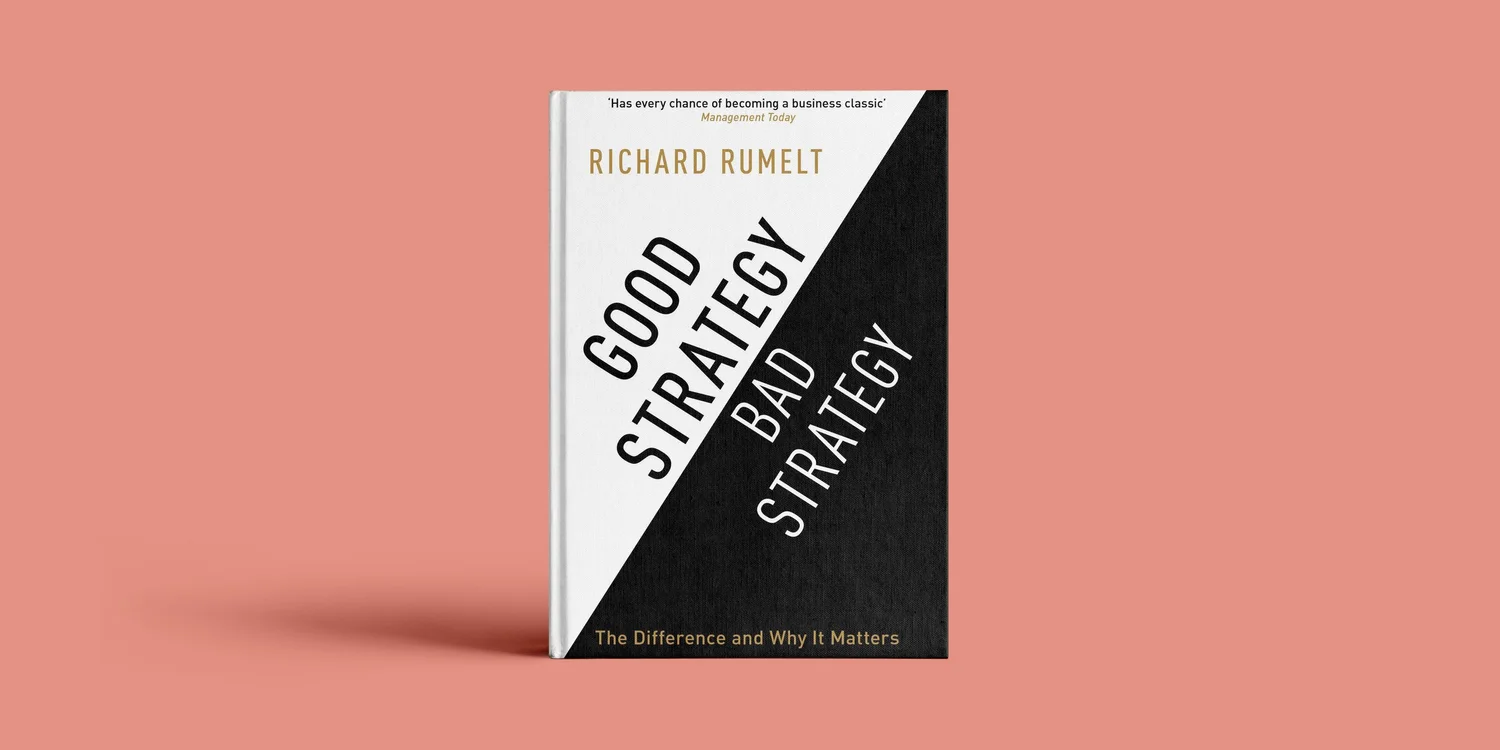
Good Strategy Bad Strategy
The Difference and Why It Matters
Richard P. Rumelt
- What it's about
- Richard Rumelt wrote Good Strategy/Bad Strategy to fix a frustrating, expensive confusion: in many organisations, “strategy” has become a decorative word. It gets attached to annual planning decks, lofty vision statements, and long lists…
- Why read it next
Richard Rumelt explains that good strategy begins with a clear diagnosis, a guiding policy, and coherent action. The book helps turn a broad understanding of a system into focused choices about the challenge that matters most.
It is a strong next read because Thinking in Systems teaches you to see structure and leverage, while Rumelt teaches you how to concentrate action around that diagnosis.