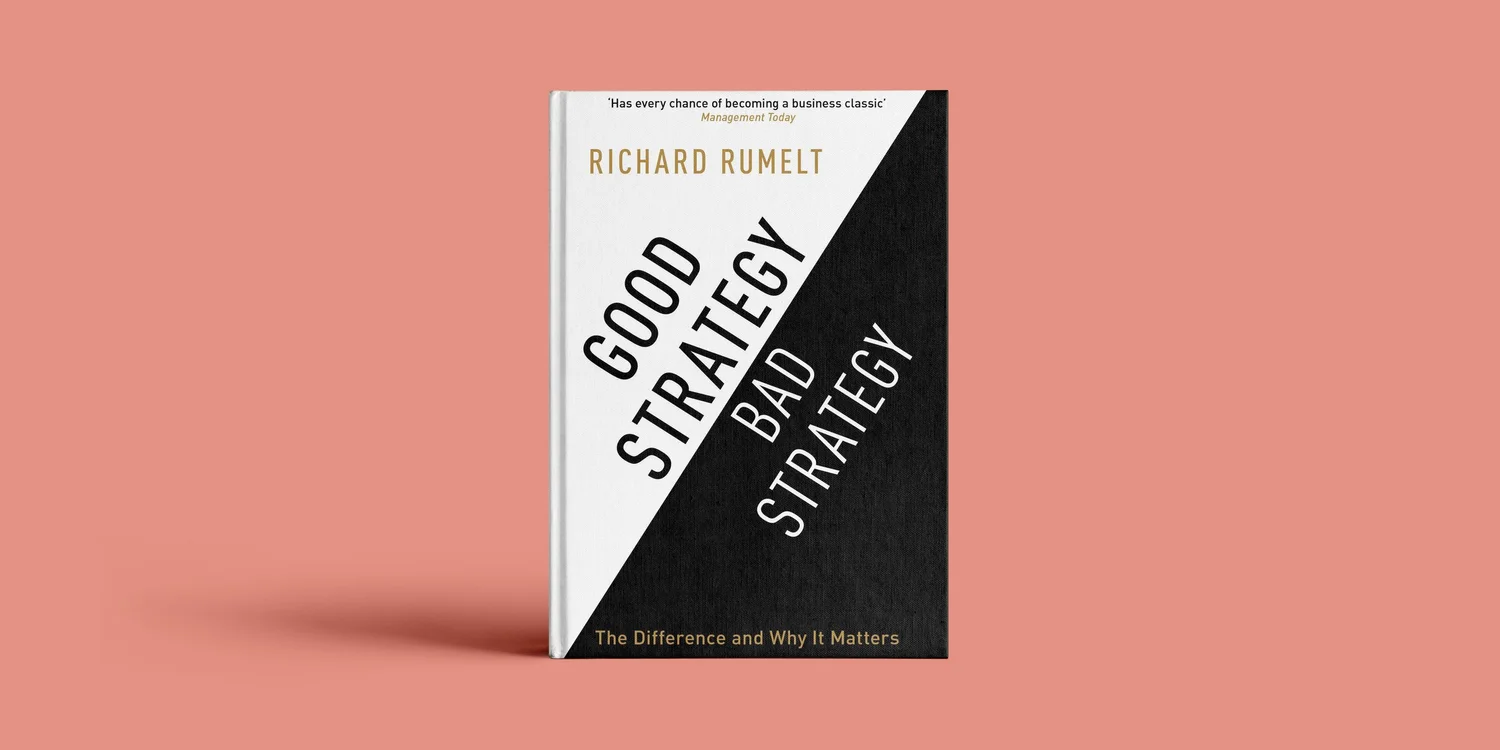
Why this book exists: strategy got replaced by theatre
Richard Rumelt wrote Good Strategy/Bad Strategy to fix a frustrating, expensive confusion: in many organisations, “strategy” has become a decorative word. It gets attached to annual planning decks, lofty vision statements, and long lists of goals—without ever forcing the hard choices that real strategy requires. Rumelt’s aim is simple and blunt: to restore strategy to its original meaning as a way of:
- confronting a difficult situation,
- creating a diagnosis about what matters, and
- concentrating effort where it can actually change outcomes. What makes the book unusually useful is its tone. It’s not motivational. It’s not “CEO poetry.” Rumelt writes like someone trying to clear fog off a windshield: he wants you to see what’s in front of you, name the obstacle, and then steer.
Rumelt’s credibility (and why his impatience is earned)
Rumelt is a long‑time strategy scholar and practitioner. He’s taught at business schools (including UCLA’s Anderson School of Management) and consulted to firms and institutions. That mix shows up everywhere in the book: the thinking is rigorous, but the examples are grounded in the real messiness of organisations—politics, incentives, and the very human tendency to replace uncomfortable analysis with comforting words.
The thesis, in one sentence
Good strategy is
- a clear diagnosis of a critical challenge,
- a guiding policy for how to respond, and
- a set of coherent actions that concentrate effort on what will matter most.
The real enemy: not ignorance, but avoidance
The surface problem is “bad strategy,” but the deeper problem is avoidance. Rumelt’s claim is that organisations often use the language of strategy to avoid the discomfort of reality: the real constraints, the trade‑offs, the hard choices, the moments where you must say “no.”
In that avoidance, you see familiar patterns. Leaders mistake aspiration for strategy—“we will be number one,” “we will delight customers,” “we will grow by 20%”—and everyone nods because it sounds positive. Or they produce an impressive catalogue of priorities so that every stakeholder feels included, but nothing becomes truly decisive. Or they copy “best practices” because it feels safe, even when the situation is different.
Rumelt’s book is really a critique of organisational theatre: when the performance of having a strategy replaces the work of making one.
The kernel: how to tell if something is actually a strategy
At the center of the book is what Rumelt calls the “kernel” of a good strategy. It’s deceptively simple, but that’s the point: it’s a test you can apply to any so‑called strategy. If these elements aren’t present, you probably don’t have one.
First is the diagnosis.
This is not a slogan, and it’s not a restatement of symptoms. It’s a judgement about what’s going on and what the pivotal obstacle (or leverage point) is. A good diagnosis reduces complexity by saying: “This is the thing that explains the situation, and this is the constraint we must deal with.” It turns noise into a pattern.
Second is the guiding policy.
The phrase can sound bureaucratic, but Rumelt means something practical: the overall approach you will take to deal with the diagnosed challenge. It’s where choice enters. A guiding policy draws boundaries. It makes it possible for people to act without re‑arguing fundamentals every time, because the organisation has decided what kind of game it is playing.
Third is coherent action.
This is the part most organisations try to substitute with a long list of initiatives. Rumelt wants the opposite: a set of coordinated moves that reinforce one another. The idea is coherence, not volume. When actions align, they create a kind of organisational force—effort compounds instead of cancelling out.
In its bare components:
- Diagnosis: what’s really going on, and what matters most.
- Guiding policy: the chosen approach.
- Coherent actions: coordinated steps that make the approach real. But the power of the kernel is less in memorising it and more in using it to interrogate language. When a plan is mostly goals, values, or vibes, the kernel exposes what’s missing.
What bad strategy looks like in the wild
Rumelt is especially good at explaining why “bad strategy” is so common. It’s not usually because people are stupid; it’s because ambiguity is comfortable. Clear strategy creates winners and losers inside an organisation. It forces trade‑offs. It makes some projects irrelevant. It implies that some cherished beliefs are wrong. So people reach for something softer.
That softness has recognisable disguises. Sometimes it’s fluff: high‑gloss language that sounds profound while refusing to commit. Sometimes it’s a “laundry list” that makes everyone feel seen while ensuring nothing becomes decisive. Sometimes it’s performance targets presented as strategy—numbers without a credible pathway. And sometimes it’s template thinking: copying what admirable companies do without understanding the specific challenge those moves were designed to solve.
How to use Rumelt’s ideas without turning them into another checklist
One of Rumelt’s most useful distinctions is between objectives and strategy.
Objectives are outcomes you’d like. Strategy is the logic and set of choices that make those outcomes plausible given the situation.
When you confuse them, you get plans that feel energetic but don’t change anything. The organisation becomes busy rather than effective.
He also pushes you to think in constraints and leverage. In many systems—supply chains, customer experiences, product development—performance is not determined by average quality but by the weakest link. Improving everything equally is comforting, but it can be wasteful.
A strategist asks: where is the bottleneck? where is the friction? where is the constraint that, if relieved, changes the entire system?
This is where his idea of “proximate objectives” becomes practical. Instead of declaring far‑off targets, set near‑term, achievable aims that build capability and momentum. The goal is not to reduce ambition; it’s to connect ambition to steps that actually move you forward. Proximate objectives are the bridge between guiding policy and coherent action.
The stories (and why they stick)
Rumelt uses a range of stories and cases to show the difference between real strategy and its imitations. The specific examples vary—from business to public institutions—but the lessons repeat.
One recurring pattern is the “fluff” strategy: documents filled with high‑gloss language that sound impressive but make no commitments. The lesson is straightforward: if you can swap your strategy document with another company’s and nothing changes, it wasn’t strategy.
Another pattern is the “everything is a priority” plan. Rumelt shows how organisations build these to avoid internal conflict. The lesson: a strategy that doesn’t create focus isn’t a strategy; it’s a peace treaty.
And then there are examples that illustrate coherence—the idea that advantage can come not from a single brilliant move, but from a system of aligned choices. The lesson here is that you’re often not trying to find one magic action. You’re trying to design a set of actions that fit together so well that the whole becomes hard to copy.
Caveats: what this book is (and isn’t)
Rumelt’s clarity is a strength, but it comes with a certain sharpness. Some readers may find the book dismissive of the emotional and cultural side of leadership. Vision and values do matter—but Rumelt’s point is that they are not substitutes for strategy.
Also, the kernel is a powerful test, but it doesn’t automatically produce great insight. A weak diagnosis can still be written in three neat lines. Rumelt would likely agree: the framework makes it harder to hide, but it doesn’t do the hard thinking for you.
Finally, Good Strategy/Bad Strategy is not a step‑by‑step manual. It’s more like a lens and a set of standards. If you want plug‑and‑play templates, you might find it less directly prescriptive than newer “strategy playbook” titles. Its value is in raising your bar for what you will call strategy.
Who this book is for
Read this if you lead projects, teams, business units, or organisations and you’re tired of plans that sound smart but don’t change behaviour. It’s especially valuable if you work in environments where “strategy” has become a ritual rather than a discipline.
Skip it (or at least don’t start here) if you’re looking for a lightweight, motivational business book. Rumelt is practical, but he is not trying to inspire you. He is trying to make you honest.
Resources (credible links)
What to read next
Summary · 11 min read
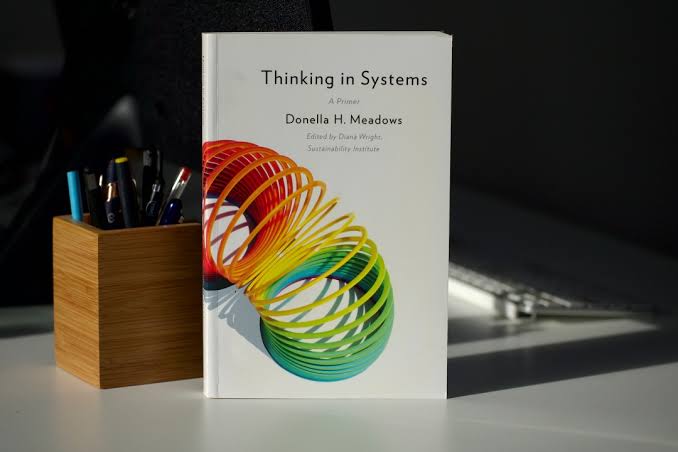
Thinking in Systems
A Primer
Donella H. Meadows
- What it's about
- Most of us are trained to solve problems by breaking them into parts. That works well when the parts are mostly independent. It works badly when they form a living system: a company, team, market, city, family, body, ecosystem, or economy.
- Why read it next
Donella Meadows explains how feedback loops, delays, goals and structures produce the behaviour we see, and where the real leverage points in a system sit.
It is a good next read because Rumelt asks you to start every strategy with an honest diagnosis, and Thinking in Systems gives you the mental models to make that diagnosis deeper and more accurate.