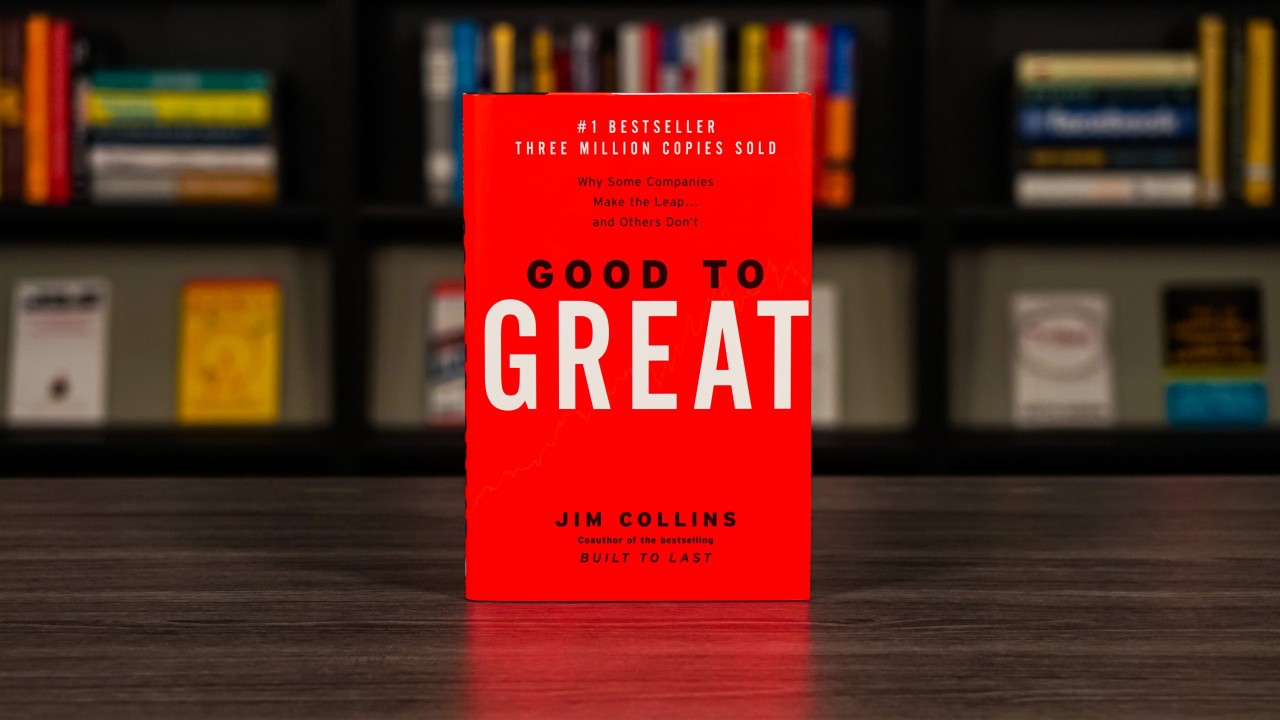
Why this book exists: “good” is a comfortable trap
Good to Great was written for leaders in a very specific situation: the organisation isn’t failing, but it also isn’t truly great. It’s profitable enough, respected enough, and “fine” enough that nobody feels urgency. Jim Collins argues that this is exactly the danger—because once you’re good, you stop doing the hard, clarifying work that greatness requires.
Collins and his research team set out to study companies that made a sustained leap in performance (not a one‑year spike) and to compare them to similar companies that did not. The book’s promise is not “here’s the new genius trick.” It’s almost the opposite: greatness is usually built by a set of surprisingly ordinary disciplines, executed relentlessly over a long time.
Why Jim Collins’ view carries weight
Collins is a business researcher and writer known for building management ideas out of comparative research rather than personal opinion. Good to Great followed his earlier work (Built to Last, co‑authored with Jerry Porras), and it reflects the same obsession: not “what do great leaders say,” but “what do great organisations consistently do?”
His voice in this book is also intentionally unglamorous. He’s not trying to turn you into a charismatic visionary. He’s trying to make you more disciplined: in people decisions, in strategic focus, and in what you refuse to do.
The thesis, in one sentence
Great companies aren’t built by one big move; they’re built by disciplined people who make a small number of clear choices and then execute them with relentless consistency long enough for momentum to compound.
The deeper problem: we want dramatic transformation, but greatness is usually quiet
A lot of leadership culture worships the dramatic: big turnarounds, bold pivots, inspirational speeches, the “new CEO” storyline. Collins’ core argument is that sustained greatness rarely looks like that from the inside.
Good‑to‑great transformations tend to feel like an accumulation—like turning a massive flywheel one heavy rotation at a time. There isn’t a single defining moment. There’s a pattern of decisions, repeated over years, that gradually creates momentum. The danger is that humans hate this story. We want the heroic move. We want the rebrand. We want the new strategy deck. And we often ignore the slower work that actually builds endurance.
The core framework: the six moves that show up in good‑to‑great companies
Collins’ research distills into a set of interlocking disciplines. They’re not meant to be a checklist you “implement.” They’re meant to be a way of operating.
Level 5 leadership: humble, stubborn, and cause‑first
The most counterintuitive finding is what Collins calls “Level 5 leadership.” The leaders at the center of the good‑to‑great transitions were not the loud, celebrity CEOs. They were often quiet, reserved, and intensely determined.
A Level 5 leader combines two traits that don’t usually come together:
- Personal humility (credit goes outward; responsibility comes inward)
- Fierce professional will (a stubborn commitment to the organisation’s long‑term greatness) This is not “nice leadership.” It’s demanding leadership—but the ambition is aimed at the mission and the institution, not the leader’s ego.
First who, then what: get the right people before you decide the plan
Collins argues that great companies don’t start with “where are we going?” They start with “who’s on the bus?”
That doesn’t mean hiring “A‑players” as a vibe. It means:
- Get the right people in the right seats.
- Get the wrong people off the bus.
- Then decide the direction. The logic is simple: if you have the right people, you can adapt your strategy as reality changes. If you have the wrong people, no strategy will save you—because execution becomes politics, protection, and constant re‑selling.
Confront the brutal facts (and keep faith): the Stockdale Paradox
This is one of the most useful ideas in the book because it names a real leadership failure mode: either toxic positivity (“everything’s fine”) or despair (“we’re doomed”).
Collins uses Admiral Jim Stockdale’s experience as a POW to describe the paradox:
- You must never lose faith that you will prevail in the end.
- And you must confront the most brutal facts of your current reality. Great organisations don’t avoid hard truth. They build cultures where truth can be spoken without being punished—and then they use that truth to make sharper decisions.
The Hedgehog Concept: a simple focus built from deep understanding
The “Hedgehog Concept” is Collins’ way of explaining strategic simplicity. Great organisations tend to discover (not invent) a clear organising idea—then they align everything to it.
It sits at the intersection of three questions:
- What can we be the best in the world at? (not what we want to be)
- What are we deeply passionate about?
- What drives our economic engine? (the key denominator that most strongly drives results) The point isn’t to create a slogan. The point is to develop clarity so strong that it becomes a filter: if an opportunity doesn’t pass the hedgehog test, you say no—even if it looks exciting.
A culture of discipline: freedom inside a clear framework
Collins is careful here: discipline is not bureaucracy. A disciplined culture is one where people don’t need to be tightly managed because they manage themselves against shared standards.
In practice it looks like:
- Disciplined people: you don’t need heroic motivation because you hired for values and maturity.
- Disciplined thought: you don’t drift; you keep returning to the hedgehog.
- Disciplined action: you execute consistently, without drama. This is where “freedom and responsibility” becomes real. The organisation gives autonomy, but within a very clear set of commitments.
Technology accelerators (not causes): use tech to amplify momentum, not create it
One of Collins’ most practical cautions is that technology rarely creates greatness on its own. Great companies use technology like a turbocharger: it accelerates an engine that already exists.
They don’t chase tech because it’s trendy. They adopt technologies that fit their hedgehog concept and make their flywheel turn faster.
The Flywheel, not the doom loop: momentum is built, not announced
The “flywheel” is Collins’ metaphor for cumulative momentum. Each push is heavy and looks unimpressive. But over time, the wheel spins faster, and what used to be hard becomes easier.
The opposite is the “doom loop”: leaders announce a new programme, a new direction, a new restructuring—without building consistent momentum. People get trained to wait it out, because “this too will pass.”
Practical understanding: how to apply the ideas without turning them into a cult
The danger with business classics is that people try to “implement” them like software. Collins’ ideas work better as tests and habits.
Start with people because it’s upstream of everything. If you’re constantly managing performance, motivation, and alignment, you probably have a “who” problem. Getting the right people is not quick, but it is leverage.
Use the Stockdale Paradox as a leadership operating system. In meetings, you can ask:
- What are we refusing to see?
- What facts do we already know but aren’t naming?
- What would be true if we were being completely honest? Treat the Hedgehog Concept as a decision filter, not a branding exercise. The real work is in the “best in the world at” question—because it forces humility. It also forces strategy to become specific: you can’t be the best at everything.
Finally, protect the flywheel from “initiative addiction.” If you want momentum, you need consistency more than novelty. A good rule is: don’t add something new until you’ve stopped something old.
Essential narratives: the stories that teach the framework
The most important “story” in Good to Great is not a single company case; it’s the repeated pattern across companies.
First, greatness often begins with a leader who is unusually determined but not self‑promoting. The organisation doesn’t become great because the leader is magnetic. It becomes great because the leader builds a disciplined system and pushes for excellence without needing to be the hero.
Second, the breakthrough tends to start with a handful of hard decisions—especially about people and focus. Greatness often shows up as subtraction: saying no, removing misfit leaders, and abandoning distracting opportunities.
Third, the transformation is usually invisible while it’s happening. From the inside, it feels like “we’re just working.” The flywheel makes it look obvious only in hindsight.
Notes, critiques, and caveats
The book is influential, but it’s not immune to reasonable criticism.
One critique is methodological: when you select “winners” from a large population and look backward, you can accidentally confuse correlation with cause. Some companies that looked great in the book later declined, which raises a fair question: did they stop doing the principles, or were the principles never the real cause?
Another critique is that the framework can feel overly neat compared to real organisational life. Culture, politics, market timing, and luck can’t be cleanly controlled. Collins acknowledges some of this elsewhere (for example in his later work on luck), but Good to Great can still be misread as a recipe.
The healthiest way to hold the book is: the principles are useful disciplines, not guarantees. They raise the probability of enduring excellence, but they don’t remove uncertainty.
Reader fit: who should read this (and who shouldn’t)
Read this if you lead a team, a business unit, or a company and you suspect your biggest threat isn’t failure—it’s comfortable mediocrity. It’s especially useful if you want language and concepts to build focus, discipline, and momentum.
Skip it (or treat it lightly) if you’re looking for a tactical playbook for startups, or if your environment is changing so fast that “best in the world at” is hard to define. The ideas still help, but you’ll need to translate them into shorter cycles.
Resources (credible links)
What to read next
Summary · 7 min read
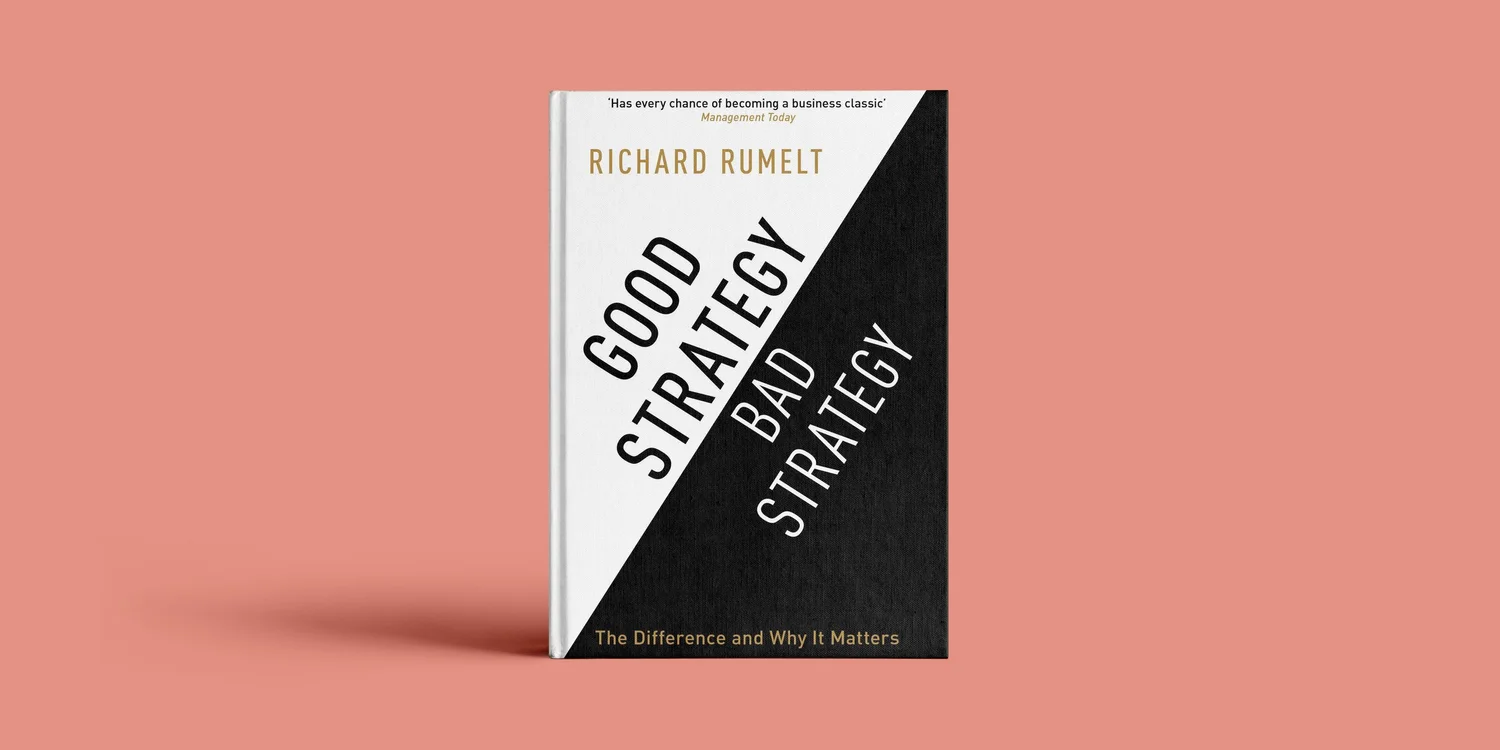
Good Strategy Bad Strategy
The Difference and Why It Matters
Richard P. Rumelt
- What it's about
- Richard Rumelt wrote Good Strategy/Bad Strategy to fix a frustrating, expensive confusion: in many organisations, “strategy” has become a decorative word. It gets attached to annual planning decks, lofty vision statements, and long lists…
- Why read it next
If Good to Great gave you a language for discipline and momentum, a great next step is to pair it with a book that sharpens your thinking about what “strategy” actually is.
Read Good Strategy Bad Strategy: The Difference and Why It Matters. It complements Collins beautifully: Collins tells you how great companies behave over time; Rumelt gives you a clear test for whether your “strategy” is real or just theatre. Together, they push you toward focus that is both disciplined (Collins) and intellectually honest (Rumelt).