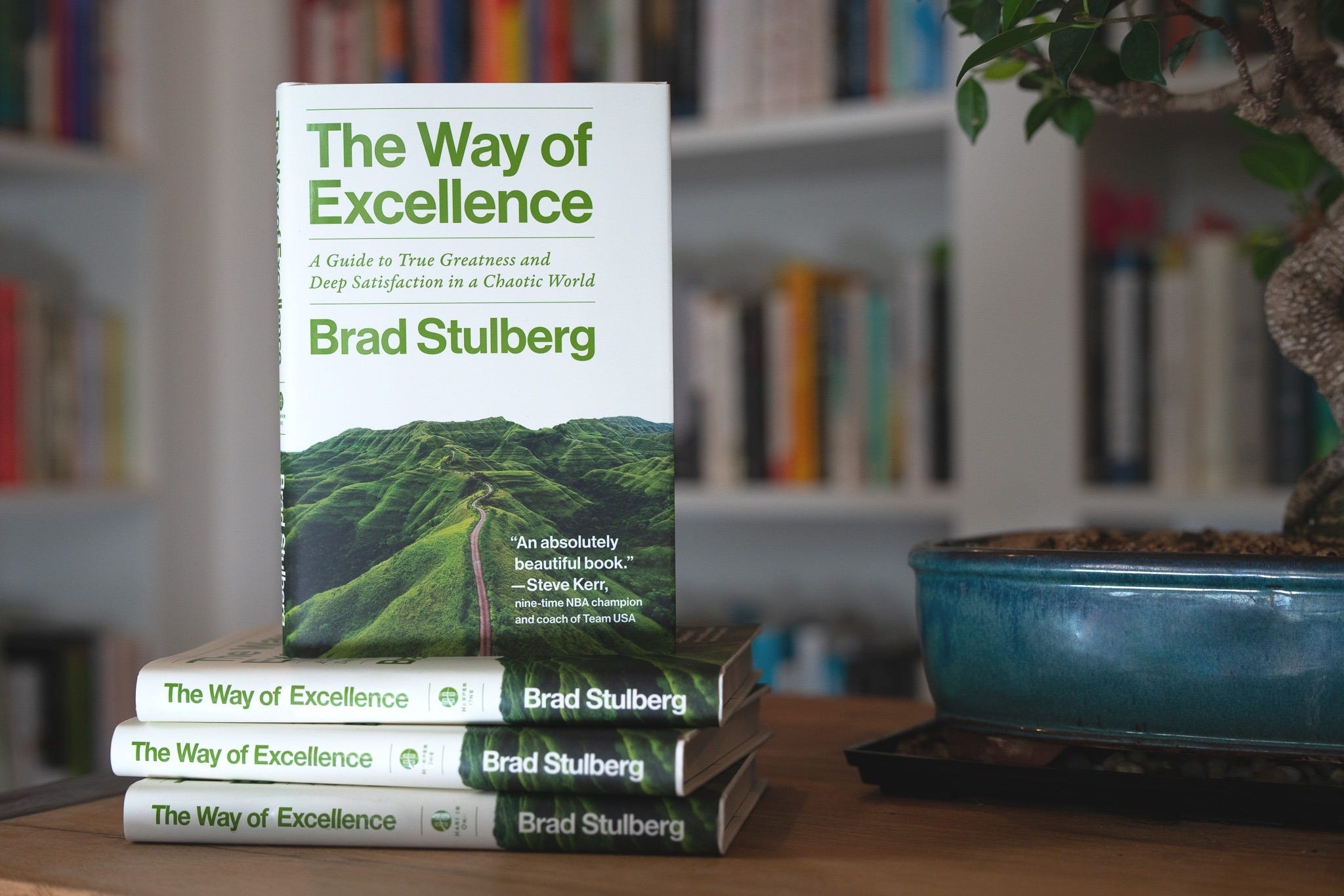
Why this book exists
Brad Stulberg wrote The Way of Excellence as an antidote to modern “zombie burnout”: the drained, distracted feeling of moving through a chaotic world while still trying to do meaningful work. The book argues that most people don’t need more hacks, intensity, or self-optimization. They need a clearer, sturdier relationship with excellence—one that produces both high performance and deep satisfaction.
The promise is simple: you can pursue greatness without losing yourself. Excellence can be a path you walk—built on practice, values, and attention—rather than a finish line you chase.
Who Brad Stulberg is (and why it matters)
Stulberg is known for writing and coaching on sustainable performance and well-being. He’s worked with high performers (athletes, leaders, creatives) and brings a “both/and” perspective: ambition and health, rigor and humanity. That mix shows up throughout the book—he’s not anti-achievement, but he is strongly anti-obsession.
The thesis in one sentence
Excellence isn’t an outcome you win—it’s a values-aligned practice you commit to, day after day, in a way that builds both true greatness and deep satisfaction.
The deeper problem the book is really addressing
Modern life quietly pushes people toward a brittle version of excellence:
- Externalized: defined by status, metrics, and other people’s approval.
- Fragmented: attention is constantly pulled apart by devices, feeds, notifications, and nonstop inputs.
- Anxious: the pursuit becomes a way to prove worth, not express it. In that environment, even “success” can feel hollow. Stulberg’s core claim is that humans are wired to strive, but we suffer when striving gets hijacked by ego, comparison, and distraction. The fix is not to stop caring—it’s to care with structure, integrity, and groundedness.
How the book “works”: excellence as a practice, not a mood
A central move Stulberg makes is shifting excellence from something you feel to something you do.
If excellence depends on motivation, inspiration, or perfect conditions, it collapses. But if it is a practice—like showing up for training, craft, parenting, leadership, or service—then it becomes more stable than your emotions and more durable than your circumstances.
This is where the book becomes demanding: it asks you to stop negotiating with your values every day. Not by becoming rigid, but by becoming consistent.
Practical ideas you can actually use
Define your version of excellence (before the world does)
The book repeatedly returns to one question: What does “excellent” mean for you, in this season of life?
If you don’t answer it, the default definitions seep in: more output, more recognition, more speed, more busyness. Stulberg pushes for a definition rooted in values and contribution.
A useful way to apply this:
- Identify 3–5 core values that you want your work and life to express.
- Translate each value into observable behaviors (what it looks like on a random Tuesday).
- Use those behaviors as your “excellence scoreboard,” not just outcomes.
Protect attention like it’s your life force (because it is)
In a chaotic world, attention becomes the bottleneck for excellence. Not talent. Not information. Attention.
Stulberg treats deep focus as a moral and practical choice: you can’t do excellent work while living in constant interruption. You can do busy work, performative work, reactive work—but not your best work.
Applied simply:
- Create predictable blocks of distraction-free time.
- Reduce “open loops” (constant checking, constant switching).
- Treat your environment as part of your character: what surrounds you shapes what you do.
Consistency beats intensity
Excellence is not built by occasional heroic efforts. It’s built by repeatable practice.
This idea sounds obvious, but it changes how you train, create, lead, and learn:
- Aim for the pace you can sustain, not the pace that impresses people.
- Build routines that make it easier to do the right thing than the wrong thing.
- When you miss, return quickly—no drama, no identity crisis.
Integrity: align actions with values under pressure
The book emphasizes that excellence is clearest when things get hard: when you’re tired, when you’re stressed, when nobody is watching, when you could cut corners.
Stulberg’s version of integrity isn’t about being “good.” It’s about being aligned—so your excellence doesn’t depend on perfect conditions.
A concrete practice here is to define your non-negotiables (a small set): the behaviors you keep even when life is messy.
Don’t build excellence on a single pillar
A subtle point that shows up in Stulberg’s broader work (and is echoed in discussions around the book) is that people do better when their identity isn’t trapped in one fragile bucket.
If everything is riding on one role—one project, one title, one metric—pressure skyrockets and perspective collapses. A healthier approach is having multiple “rooms” in your life that matter: craft, relationships, health, learning, community, play. Excellence becomes more stable because your sense of self is not one failure away from falling apart.
Essential narratives (the kind that teach)
Rather than leaning on one grand story, the book’s narrative arc is the contrast between two paths:
- The obsessive path: chasing outcomes for validation, living in distraction, over-identifying with achievement, and eventually burning out or feeling empty.
- The excellent path: committing to deliberate practice, aligning with values, protecting attention, and finding meaning in the process. The “story” is essentially a portrait of the modern striver—and the invitation to become a different kind of striver.
Notes, critiques, and caveats
- “Excellence” can be a loaded word. For some people, it’s tied to perfectionism, shame, or never feeling enough. The book’s intent is to rescue excellence from those traps, but the word itself may still trigger the wrong mindset. If that’s you, you may need to translate “excellence” into “craft,” “service,” or “practice.”
- The advice is simple, not easy. Protect attention, define values, be consistent—none of this is complicated. The hard part is social and environmental: most workplaces and technologies reward reactivity. The book is strongest as a personal philosophy; it may require organizational change to fully live it.
- Some readers may want more structure. If you prefer highly tactical, step-by-step systems, parts of this will feel more like a guiding compass than a detailed map.
Who this book is for (and who it isn’t)
This book is for you if:
-
You care deeply about doing great work but feel exhausted by the modern attention economy.
-
You want ambition without constant anxiety.
-
You’ve achieved things and still feel oddly unsatisfied.
-
You’re trying to build a sustainable practice—creative, professional, athletic, or personal. It may not be for you if:
-
You want a productivity “playbook” with lots of specific tactics and templates.
-
You’re in a season where survival and rest are the priority; the excellence frame might feel like extra pressure (even though the book argues against that kind of pressure).
Resources
What to Read Next
Summary · 6 min read
Digital Minimalism
Cal Newport
- What it's about
- Cal Newport wrote Digital Minimalism as a pushback against a quiet cultural shift: we went from using helpful tools to living inside an always-on attention economy. His claim is not that technology is evil, but that we adopted it by…
- Why read it next
If The Way of Excellence is about committing to a values-based practice in a chaotic world, Digital Minimalism is a practical companion for removing one of the biggest sources of chaos: the constant pull of technology. It helps you redesign your digital life around what you truly value, so your attention can support excellence instead of being endlessly fragmented.