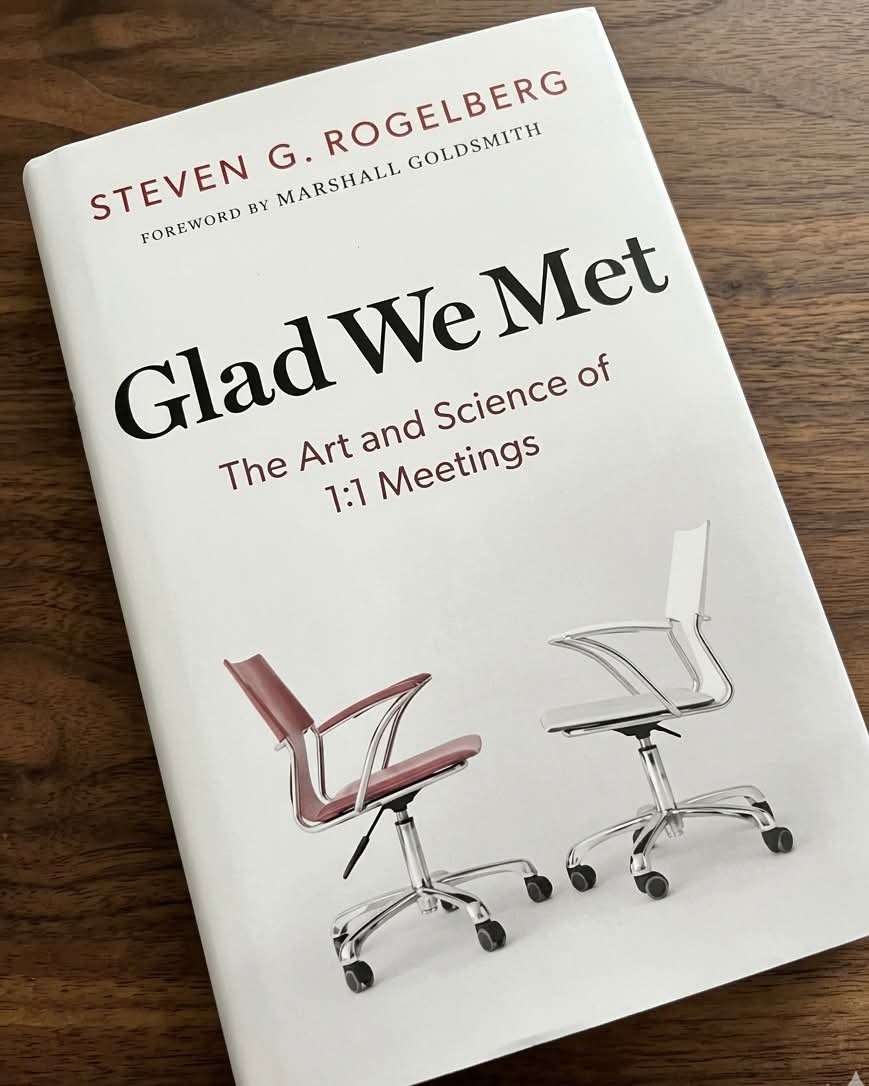
Why this book exists
Most managers run 1:1s, but very few are ever taught how. Steven Rogelberg wrote Glad We Met because the data is damning: nearly half of all 1:1s are rated as suboptimal by team members, while managers consistently overrate their own performance in them. That gap is the whole problem the book is trying to close.
Rogelberg's argument is that 1:1s are not a soft, optional ritual. They are the highest-leverage management activity most leaders have — and they are being wasted. With an estimated 200–500 million 1:1s happening around the world every day, even small improvements in how they're run translate into massive gains in engagement, retention, growth, and team performance.
Who Steven Rogelberg is (and why it matters)
Rogelberg is an organisational psychologist and Chancellor's Professor at UNC Charlotte, where he founded the Organisational Science program. He's spent decades studying meetings, teams, and leadership, and his earlier book The Surprising Science of Meetings was named a leadership book to watch by the Washington Post.
For this book, he ran three pieces of research: a global survey of 1,200 knowledge workers, a US survey of 250 employees, and interviews with about 50 senior leaders at Fortune 100 companies (Google, PepsiCo, Bank of America, Warner Brothers, and others). The book is genuinely research-backed, not opinion dressed up as a framework — and that is its main credential.
The thesis in one sentence
A great 1:1 is not your meeting with your direct report — it is their meeting, orchestrated and supported by you, and when you treat it that way it becomes the single most valuable hour on a manager's calendar.
The deeper problem the book is really addressing
Under the surface, Glad We Met is arguing against three common defaults:
- 1:1s as status updates. Many managers use the time to ask "what are you working on?" — information they could get from a doc, a board, or async tools. This wastes the one opportunity for a focused human conversation.
- Manager-centric agendas. When the boss owns the agenda, the meeting drifts toward what the boss cares about (delivery, control, oversight) and away from what the direct report actually needs (clarity, support, growth, obstacles).
- Inconsistency. Cancelled, rescheduled, or hijacked 1:1s send a quiet message: you are not a priority. Rogelberg's data shows that consistency itself is one of the strongest signals of care. The fix isn't a clever new template. It's a shift in who the meeting is for.
How the book works: the 1:1 as the direct report's meeting
The central reframing is simple and surprisingly demanding: the 1:1 belongs to the direct report. The manager's job is to make it useful for them — by holding the space, asking better questions, listening more than talking, and following through.
That single move reshapes everything downstream: cadence, length, location, agenda, who prepares what, how you open and close, and how you handle development versus delivery topics.
Practical ideas you can actually use
Cadence: more often than you think, shorter than you think
Rogelberg's research lands on a clear default: about four 1:1s a month, typically weekly, around 30 minutes. Bi-weekly can work for senior, autonomous reports; monthly is usually too thin to build trust or catch issues early.
The research is blunt on one point: there is no evidence you can do too many 1:1s, but plenty of evidence you can do too few. If in doubt, err toward more frequent and shorter rather than rare and long.
Treat consistency as a non-negotiable
Cancelling a 1:1 is rarely "just this once" in the direct report's experience. Rogelberg argues that reliability is one of the strongest trust signals a manager has. Practical implications:
- Reschedule rather than cancel.
- Protect the slot like you'd protect a board meeting.
- If you must move it, do so personally and explain why.
Use an agenda — and let the direct report own it
Roughly half of 1:1s have no written agenda. The ones that do are rated more positively. The highest-rated 1:1s are those where the agenda is built jointly, or by the direct report alone. Manager-only agendas are the worst-performing configuration.
A practical setup:
- A shared doc the direct report writes into.
- The manager adds items but does not dominate the list.
- Standing prompts to surface what would otherwise stay hidden (see below).
Ask better questions
The single biggest predictor of 1:1 value, in Rogelberg's data, is the active participation of the direct report. That participation has to be invited.
A rotating set of high-quality questions does more work than any template. Examples Rogelberg draws on:
- What's been on your mind that we haven't talked about?
- Where do you feel stuck, and what would unstick you?
- What is energising you right now? What's draining you?
- What feedback do you have for me?
- What's one thing I could do differently that would help you?
- How are you doing — not just on work, but overall? The goal is not to interrogate. It is to make it easier for the direct report to bring real things into the room.
Listen more than you talk
A rough heuristic from the book: the manager should be talking far less than half the time. If you walk out feeling like you covered a lot, you probably hijacked the meeting. If you walk out feeling like you mostly listened and asked, you probably ran it well.
Balance the short-term and the long-term
Rogelberg pushes against two failure modes:
- All tactical (delivery): the meeting becomes a status check. Growth, career, wellbeing, and relationship topics never get oxygen.
- All developmental: the meeting floats above reality and loses urgency. The healthier pattern is to keep most 1:1s grounded in current work and deliberately rotate in development, feedback, relationship, and career topics — not as a special event, but as a steady drumbeat.
Location and format matter more than people think
In-person 1:1s tend to be rated slightly higher than virtual ones, and the manager's office or a quiet conference room tend to outperform open spaces. Walking 1:1s can work well for certain conversations. The point is not that one setup wins — it's that the format is a choice, and most managers don't make it consciously.
Close with clarity
A good 1:1 ends with shared understanding of:
- What was decided.
- What each person is doing before the next meeting.
- Anything that needs to be escalated or revisited. This takes two minutes and is the most commonly skipped part.
Essential narratives (the kind that teach)
Rather than a single hero story, Glad We Met is built around a contrast between two recognisable archetypes:
- The well-intentioned but ineffective manager. They hold 1:1s, but cancel them when crunch hits, run them as status updates, do most of the talking, and rate themselves highly because the meetings happened. Their direct reports privately disengage.
- The deliberate manager. They treat 1:1s as the direct report's meeting, build the agenda jointly, ask thoughtful questions, listen, follow through, and protect the slot fiercely. Their direct reports describe them as the best manager they've ever had. The lesson is that the difference between these two is not personality or charisma. It is a small set of repeatable behaviours.
Notes, critiques, and caveats
- Light on edge cases. The book is at its best on the "healthy default" 1:1. Some reviewers note that it gives less attention to harder situations — managing up, skip-levels, distributed teams across many time zones, or 1:1s during organisational turmoil. You'll likely need to adapt the playbook for those contexts.
- Some repetition. Rogelberg circles back to core points (it's the direct report's meeting; cadence matters; ask, don't tell) more than once. For some readers this reinforces the message; for others it can feel padded.
- Manager-centric framing. The book is primarily aimed at managers running 1:1s with their direct reports. Direct reports themselves can get a lot out of it, but they have to do some translation work — there isn't an equivalent "how to get the most out of your 1:1 as an employee" arc with the same depth.
- Cultural defaults are mostly Western/corporate. The research draws heavily on US and Fortune 100 environments. The principles travel, but specific norms (location, candor, feedback styles) will need calibration in different cultures.
- Risk of mechanising a human conversation. Apply too many of the tactics at once and a 1:1 starts to feel like a checklist. The book's spirit is that structure should serve the conversation, not replace it. Worth keeping in mind.
Who this book is for (and who it isn't)
Read it if you:
-
Manage people and want to dramatically improve the most important meeting on your calendar.
-
Are stepping into your first management role and want a research-backed default to build from.
-
Lead managers and want a shared standard for what "good" looks like across your org.
-
Are a coach or HR/People leader designing manager enablement. It may not be the right book if:
-
You want a broad theory of leadership rather than a focused, tactical guide.
-
You're looking for deep coverage of group meetings or organisational meeting culture (the earlier Surprising Science of Meetings is a better fit for that).
-
You already run excellent 1:1s and want advanced, edge-case material — much of this will be reinforcement rather than new ground.
Resources
What to Read Next
Summary · 5 min read
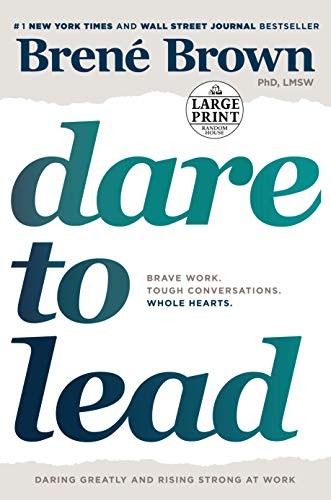
Dare To Lead
Brené Brown
- What it's about
- Dare to Lead exists because many organisations say they want “leaders,” but reward self-protection: pretending to know, avoiding hard conversations, managing perception, and staying safe. Brené Brown argues that this creates cultures of…
- Why read it next
Brené Brown's research-backed guide to courageous, values-driven leadership, built around skills like rumbling with vulnerability, living into values, and braving trust. It's the natural next read because Glad We Met gives you the structure and cadence of great 1:1s, while Dare to Lead gives you the inner toolkit — feedback, candor, and trust — to actually use that time well when conversations get hard.