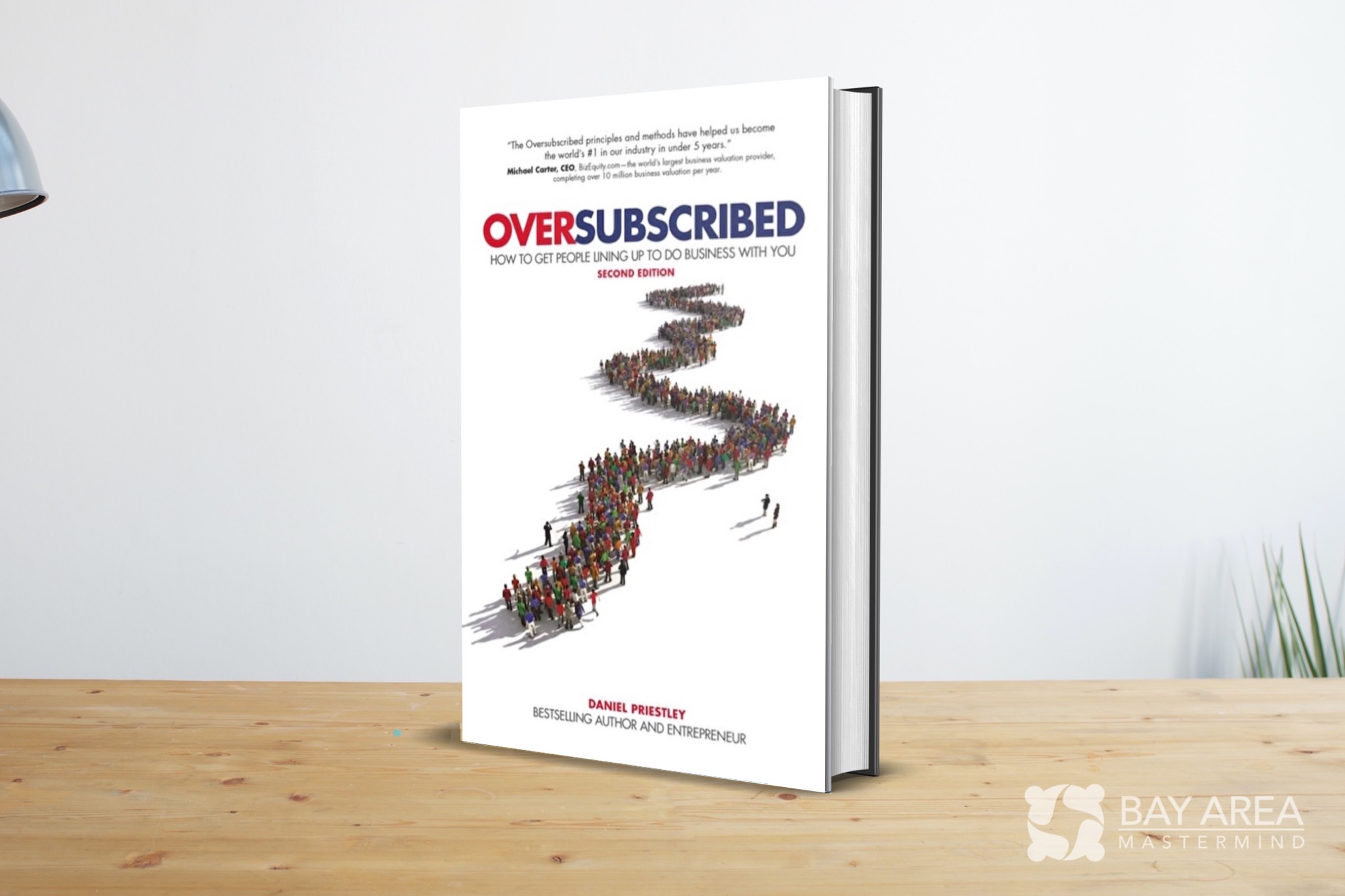
Why this book exists: most businesses fight for customers instead of being fought over
Daniel Priestley wrote Oversubscribed for the founder, marketer, or business owner who is tired of chasing customers, discounting to close, and competing on price. The frustration he is addressing is specific: most businesses live in a state of undersubscription — too much supply, not enough demand — and so they spend their lives convincing reluctant prospects and grinding for thin margins.
Priestley's argument is that this is a structural problem, not an effort problem. If you organise your business around generating more demand than you can supply, almost every other problem (pricing, conversion, marketing spend, team morale) becomes easier. The book is essentially a practical recipe for engineering that imbalance on purpose.
It's written for entrepreneurs, small-to-mid-sized business owners, product launchers, and anyone running campaigns — but the underlying logic generalises to anyone who has something to sell and a market to reach.
Who Daniel Priestley is (and why this book lands)
Daniel Priestley is an Australian entrepreneur who moved to London in 2006 and co-founded Dent Global, an accelerator that helps entrepreneurs become "key people of influence" in their industries. He has built and exited multiple seven- and eight-figure companies and is the author of Key Person of Influence, Entrepreneur Revolution, 24 Assets, and Oversubscribed.
His credibility here isn't theoretical. He has personally run product launches, built communities, and coached thousands of founders through campaign-based business models. That practitioner background shows up in the tone of the book — it reads like field notes from someone who has actually engineered demand, not like an academic explanation of marketing theory.
The thesis in one line: engineer demand, then sell
The only businesses that make real profit are the ones where demand outstrips supply — so the job of an entrepreneur is to deliberately engineer that imbalance before you ever try to sell.
The deeper problem: most businesses are stuck in the "search for customers" trap
Priestley sketches four states a business can be in: searching (struggling to find buyers), undersubscribed (more supply than demand), balanced (supply roughly equals demand), and oversubscribed (demand outstrips supply). Most owners assume "balanced" is the goal. Priestley argues that's a trap — balance still means you have to convince every customer, discount to close, and compete on price.
The deeper move underneath the book is a mindset shift: stop trying to find customers and start trying to attract them. Stop optimising the sales conversation and start optimising the conditions before the sales conversation happens. By the time someone is talking to you about buying, the work of demand should already be done.
This reframes the role of the entrepreneur. You are not primarily a salesperson. You are a campaign manager, a community builder, and an architect of attention.
How the book works: the seven principles and the Campaign Driven Enterprise
The book is structured in two halves. The first half lays out the principles for why oversubscription happens. The second half gives a five-phase methodology for how to engineer it.
The seven principles of oversubscription
In plain English, Priestley argues that businesses become oversubscribed when:
- Supply and demand set the price. Pricing isn't about cost-plus or competitor benchmarks — it's about the imbalance between what's available and what's wanted.
- You separate yourself from the market. If you look and sound like everyone else, you'll be compared on price. The escape is to be meaningfully different in a way buyers care about.
- You exploit one of the four market drivers: innovation, relationships, convenience, or price. Most oversubscribed businesses lean hard into one or two of these, not all four.
- You design the buying environment. Where, when, and how people encounter your offer changes whether they buy. A queue, a launch, a waiting list, an event — these aren't accidents, they're staged.
- It's okay to be different. Trying to be acceptable to everyone is what creates undersubscription. Oversubscribed businesses are willing to repel the wrong audience to delight the right one.
- Value lives in the ecosystem. Your product alone is rarely the whole offer. The community, content, supporting tools, and reputation around it are part of what people are buying.
- Nothing beats being positively remarkable. Word of mouth — the cheapest and most powerful demand engine — only fires when the experience itself is worth talking about. These aren't independent tips. They're a layered system: differentiation creates the conditions for word of mouth; ecosystem creates the conditions for differentiation; buying environments amplify both.
The Campaign Driven Enterprise (CDE) Model
The second half of the book is the part that makes the principles operational. Priestley argues that oversubscribed businesses don't run on a steady, always-on sales process. They run on campaigns — concentrated bursts of attention, signal-gathering, and release.
The five phases are:
- Phase 1 — Plan the campaign. Decide what you're selling, who it's for, how much you can deliver, and by when. Capacity is set deliberately and kept finite. Scarcity isn't a trick here; it's a constraint you respect on purpose.
- Phase 2 — Build up. Long before you sell, you generate signals of interest: subscribers, waiting lists, event attendees, downloads, preorders, conversations. The goal isn't sales yet; it's evidence of demand.
- Phase 3 — Release when oversubscribed. Only open the doors when interest meaningfully exceeds capacity. Priestley gives a rough rule of thumb: roughly 5× engagement for strong-signal interest (preorders, deposits), 10× for medium signal (event attendance, list signups), and up to 100× for weak signal (clicks, views). Selling before you hit these thresholds is what creates struggling launches.
- Phase 4 — Deliver remarkably. Exceed expectations in a way that creates stories. The delivery phase is where the next campaign is actually built, because remarkable delivery is what drives the word of mouth that fuels the next round.
- Phase 5 — Celebrate and innovate. Mark the win publicly (which itself is marketing), debrief honestly, and feed what you learned into the next campaign. The CDE is essentially a loop, not a funnel. Each campaign creates the audience, the proof, and the reputation that make the next campaign easier.
Moves you can borrow from the book this week
Market for signals, not sales
One of the most useful reframes in the book is this: in the build-up phase, your job is not to sell — it's to collect signals. A signal is any voluntary act of interest: a subscription, an RSVP, a download, a question, a deposit. The mistake most businesses make is trying to close before they've gathered enough signal. Priestley's discipline is to keep counting signal until it clearly exceeds capacity, and only then open the gate.
Cap your capacity on purpose
Most businesses treat capacity as something to maximise. Priestley treats it as something to declare. Decide how many clients, seats, units, or slots you can deliver remarkably — and then stop. Real scarcity ("we take twelve clients a quarter") changes the psychology of buying in a way that fake scarcity never can, because the constraint is honest and the delivery quality is protected.
Use the four drivers honestly
Innovation, relationships, convenience, and price are the four ways markets get knocked out of balance. Most undersubscribed businesses are vaguely competent at all four and excellent at none. Pick one or two and lean in. A premium consultancy probably wins on relationships and innovation; a low-cost retailer wins on price and convenience. Trying to win on all four usually means winning on none.
Build an ecosystem, not just a product
Priestley keeps returning to the point that the product is rarely the full offer. The community around it, the content that teaches it, the tools that support it, the events that surround it, and the people you get introduced to by buying it are all part of what people are actually paying for. When your ecosystem is rich, your pricing power goes up — and your competitors' ability to copy you goes down.
Be positively remarkable, deliberately
"Remarkable" is not a vague aspiration. Priestley treats it as a design problem: what specific moments in the customer experience are worth a story? Then engineer those moments on purpose. A surprise, a personal touch, a faster-than-expected response, a thoughtfully wrapped delivery — these aren't fluff, they're the raw material of word of mouth.
Build the team around the four roles
Late in the book, Priestley sketches the four roles needed to actually run a Campaign Driven Enterprise: a Key Person of Influence (the public face and creative direction), a Head of Sales and Marketing, a Head of Operations and Product, and a Head of Finance, Logistics and Reporting. Solo founders usually play all four — the value of naming them is that it forces you to notice which role is starving on any given week.
The stories that carry the argument
Oversubscribed is light on long case studies and heavier on short, punchy examples. A few recurring threads carry the weight.
The queue stories — restaurants with no empty tables, hairdressers with six-month waiting lists, products that sell out in a day — are used throughout the book to make a simple point: in any industry, somebody is oversubscribed, and they didn't get there by accident. They engineered it through capacity, positioning, and reputation, not by working harder than their competitors.
The product launch examples (Apple's iPhone launches, book launches, course launches, Kickstarter-style preorder campaigns) illustrate the CDE in action. The lesson is consistent: the people who look like they "got lucky" with a sold-out launch almost always ran a deliberate build-up phase that gathered far more signal than the public ever saw.
The "chapter Daniel wrestled with" is a small but famous part of the book — he tells readers there is one chapter containing an idea so valuable he hesitated to share it, but he never explicitly names which one. Most readers (and Priestley himself, on social media) point to market for signals, not sales as the answer. The lesson hidden in this device is itself a Priestley move: a piece of staged mystery that gets people talking about the book long after they finish it.
Where the book gets pushed back on (and how to read it fairly)
Oversubscribed is widely liked, but the thoughtful critiques are worth taking seriously before you apply it.
The most common critique comes from operators in B2B, enterprise, and regulated industries (writers at Enterprise Times, voices on r/Entrepreneur, and various B2B marketing commentators). Their objection is about transferability: campaign-driven launches, scarcity, and waiting lists work beautifully for consumer products, courses, events, and small consultancies — but they don't map cleanly to enterprise sales cycles where buying committees, procurement, and compliance dictate the pace. The fair caveat: treat the principles (differentiation, signal-gathering, ecosystem, remarkable delivery) as universal, and treat the CDE mechanics (waiting lists, launch dates, 5×/10×/100× rules) as best suited to consumer and SMB contexts.
A second critique is about the ethics and durability of manufactured scarcity. Brand thinkers and marketing critics (in the lineage of Byron Sharp and Mark Ritson) have pushed back on the idea that engineered scarcity is a long-term strategy. Their concern: when buyers eventually notice that the "waiting list" was theatre, the brand pays for it. Priestley is mostly careful here — he insists scarcity should be real, anchored in honest capacity — but in the wrong hands the playbook can drift into manipulation. Use the constraint as a real one, not a marketing gimmick.
A third critique focuses on scope. Reviewers on Goodreads and on long-form blog reviews note that the book is almost entirely about acquisition and demand generation, and says relatively little about the operational machine, financial discipline, or retention systems that turn an oversubscribed launch into a durable company. This isn't a flaw so much as a boundary: read Oversubscribed alongside something on operations or strategy if your time horizon is years, not quarters.
A fourth critique is about novelty. Some reviewers argue that the underlying ideas — scarcity, differentiation, word of mouth, launches — aren't new, and that Priestley's contribution is mostly to package them into a clean framework. That's largely fair. The value of the book is less in inventing concepts and more in integrating them into a single, usable system aimed at small business owners.
Finally, there's a stylistic critique: a few readers find the book's confidence and pace a touch breezy, with examples that sometimes feel pulled from a workshop rather than rigorously documented. That's mostly a matter of taste. The frameworks themselves — the seven principles and the CDE — hold up under scrutiny.
Who this is for (and who should pass)
Read this if you sell products, services, courses, events, or consulting where you control pricing, packaging, and timing — and you feel like you're constantly chasing customers, discounting, or launching to a quiet room. It's especially useful for founders planning a launch, coaches and educators building cohorts, and small business owners who want to escape "balanced and broke."
Skip it (or pair it with something else) if you're operating in long enterprise sales cycles, heavily regulated industries, or pure brand-building roles where campaign mechanics are constrained by external factors. The principles still apply; the tactics will need translation.
Where to go deeper
What to read after this

Summary · 10 min read
$100M Offers
How To Make Offers So Good People Feel Stupid Saying No
Alex Hormozi
- What it's about
- Alex Hormozi wrote $100M Offers for the small-business owner, founder, or operator who keeps grinding without the financial result to show for it. The frustration he is addressing is specific: you’re working hard, your product is decent…
- Why read it next
Alex Hormozi's book is a tactical manual for constructing offers so valuable that buyers feel ridiculous saying no, built around his Value Equation and the disciplined use of bonuses, guarantees, and risk reversal. It's aimed at founders, coaches, and service operators who want to escape price competition by engineering perceived value instead of cutting prices.
It's the natural next read because Priestley teaches you how to fill the room with demand, and Hormozi teaches you how to make the offer inside that room impossible to refuse.