
Why this book exists: most businesses are stuck competing on price
Alex Hormozi wrote $100M Offers for the small-business owner, founder, or operator who keeps grinding without the financial result to show for it. The frustration he is addressing is specific: you’re working hard, your product is decent, but you’re competing on price, your margins are thin, and every customer feels like a fight to win. You discount to close. You chase leads that don’t convert. You blame the market, the algorithm, or the economy.
Hormozi’s argument is that almost none of that is the real problem. The real problem is your offer. Most businesses sell what is essentially a commodity wrapped in a generic promise ("good service," "great quality," "fair price"), and then wonder why customers haggle. His promise in the book is blunt: if you learn how to construct an offer that is dramatically more valuable than what anyone else in your category is selling, the math of your business changes—pricing, conversion, retention, and even marketing all become easier.
It’s a tactical book aimed at owners of service businesses, agencies, coaching/education, gyms, and small product companies, but the logic generalises to anyone who has to package value and ask for money.
Who Alex Hormozi is (and why this book lands)
Hormozi built and scaled a gym-launching business, then turned the playbook into Acquisition.com, a portfolio company that invests in and helps grow small to mid-sized companies. His credibility here isn’t academic; it’s operational. He has personally negotiated, sold, and re-engineered hundreds of offers across dozens of business models.
That shows up in the book’s tone. He doesn’t theorise about value. He talks about it the way a practitioner does—what to add, what to remove, how to price, what to guarantee, and what to call it so the buyer actually feels the difference.
The big idea in one sentence
If you make your offer good enough that the perceived value massively exceeds the price, you stop competing in your market and start operating in a category of one.
The deeper problem: you are not in a pricing problem, you are in a value problem
Most owners think they have a price problem. Hormozi reframes it: you have a value problem. When the prospect can’t clearly see why your thing is worth more than the next option, they default to the only metric they understand—price. That’s the trap.
His answer is to stop trying to win a comparison on the same axis everyone else is on. Instead, build what he calls a Grand Slam Offer: an offer so specific, so valuable, and so well-constructed that the prospect can’t reasonably compare it to anything else. When that happens, the conversation shifts from “Can I afford it?” to “Can I afford to miss this?”
The deeper move underneath this is psychological. Buying is not a logical act; it’s a perceived-value act. People don’t pay for what something objectively is. They pay for what it represents, what it solves, and how confident they are that it will work for them. The book is essentially a manual for engineering all three.
How the book works: the Value Equation and the Grand Slam Offer
Hormozi gives the reader two big building blocks that show up again and again throughout the book.
The Value Equation
The core mental model is what he calls the Value Equation. In plain English, perceived value goes up when:
- the dream outcome is more desirable
- the perceived likelihood of achievement is higher
- the time delay to results is shorter
- the effort and sacrifice required is lower The first two are on the top of the equation (you want them as big as possible). The bottom two are on the bottom (you want them as small as possible). Almost every move he teaches in the book is really a way to push one of those four levers.
This is more useful than it sounds. Instead of vaguely trying to “add more value,” you can audit your offer against the equation: Am I clear about the dream outcome? Have I made it more believable? Have I reduced the time to a first win? Have I removed friction, work, or risk?
The Grand Slam Offer
A Grand Slam Offer is the practical output of running your business through the Value Equation. Hormozi’s recipe has a few consistent ingredients:
- A clear, specific dream outcome the buyer actually wants
- A bundle of components that together solve the complete problem (not just one piece of it)
- Bonuses that target the predictable obstacles that would stop someone from getting results
- Risk reversal (guarantees) so the buyer doesn’t have to be brave to say yes
- Scarcity and urgency, used honestly, so the buyer has a reason to act now
- Naming and packaging that make the whole thing feel like one obvious thing to buy The point is not to be gimmicky. The point is that most offers fail because they leave the buyer alone with their doubts. A Grand Slam Offer is constructed so that the most common reasons to hesitate are already handled before the prospect raises them.
Practical ideas you can actually use
Pick a starving market, not a clever product
Hormozi is firm: a great offer in a weak market still struggles. Before you obsess over the offer, make sure you’re selling into a group of people who already feel the pain, already want a solution, and already have the means to pay. He talks about “starving crowds”—markets with urgent, expensive problems—as the multiplier behind everything else.
Charge more, on purpose
One of the more uncomfortable arguments in the book is that low prices often hurt the buyer as much as the seller. Cheap offers attract worse clients, get taken less seriously, and don’t fund the level of service required to actually deliver the outcome. Higher prices, when matched with higher value, often produce better clients, better results, and a healthier business.
His recommendation is not “charge whatever you want.” It’s “price so that the value is obviously, conspicuously greater than what you’re asking.” Premium pricing without premium value is just arrogance. Premium value without premium pricing is a slow way to burn out.
Solve the whole problem, not just your part of it
A common mistake is to sell a slice of the solution and leave the buyer to figure out the rest. Hormozi’s instinct is the opposite: list every obstacle the buyer will hit on their way to the dream outcome, and bake the fixes for those obstacles into the offer. Each obstacle removed is value added.
This is why his offers often look “stacked.” It’s not because more stuff is better. It’s because the right additional pieces close the gap between buying the thing and getting the result.
Use guarantees to move the risk from buyer to seller
Guarantees aren’t a marketing trick in his model. They’re a structural way to make it rational for someone to say yes. When the buyer feels that the worst case has been handled, the decision becomes lighter. Hormozi spends real time on different kinds of guarantees—unconditional, conditional, anti-guarantees, performance-based—because he treats them as a craft, not a slogan.
The deeper rule: only offer a guarantee you can actually stand behind. A strong guarantee on a weak offer becomes a refund machine. A strong guarantee on a strong offer becomes a conversion machine.
Use scarcity and urgency honestly
He’s candid that scarcity and urgency are powerful precisely because they push action—but they only work long term when they’re real. Fake countdowns and made-up cohorts train the market to distrust you. Real limits (capacity, cohort size, supply, deadlines, time-bound bonuses) reward the people who decide quickly and protect the quality of your delivery.
Naming is part of the offer
Hormozi insists that the name of an offer is part of its value. A vague name forces the buyer to do work. A specific, outcome-oriented name does the work for them. He gives a simple pattern—roughly: who it’s for, what it does for them, how long it takes, and what makes it unique—and uses it to make offers feel concrete and credible without sounding like a brochure.
Essential narratives (and the lesson in each)
The book is full of short, punchy examples rather than long case studies, but a few recurring stories carry the weight.
The gym-owner stories illustrate the shift from low-ticket, commoditised offers (cheap memberships in a crowded market) to high-value, problem-solving offers (specific transformation programs with guarantees, support, and a clear outcome). The lesson is consistent: the better the offer, the easier the sale, even at higher prices.
His own pricing journey shows up in the way he describes raising prices. Every time he raised prices and added matching value, conversion either stayed the same or improved—and the business got healthier. The lesson: price is usually a symptom of value perception, not a constraint of the market.
Finally, the smaller anecdotes about losing deals because the offer was vague, or winning deals because a guarantee removed the last objection, repeat the same point: most sales aren’t lost on price; they’re lost on doubt. The offer’s job is to remove the doubt before the prospect ever has to ask.
Notes, critiques, and caveats
$100M Offers is direct and tactical, and most of the pushback against it comes from people who have applied the playbook in different contexts. The strongest critiques are worth steelmanning before you use the book.
The most common critique comes from operators outside the direct-response, high-ticket world (consultants, B2B founders, SaaS commentators on platforms like LinkedIn, Indie Hackers, and Reddit’s r/Entrepreneur). Their objection is about transferability: Hormozi’s mechanics were forged in gyms, coaching, agencies, and info products, where the seller controls pricing, packaging, and the sales conversation. In enterprise SaaS, regulated industries, or long, committee-driven B2B sales, you simply can’t pull scarcity, urgency, and stacked guarantees the same way. The critique is fair: treat the Value Equation as the universal idea, and treat the surface tactics as a domain-specific implementation.
A second critique focuses on the ethics and durability of stacking. Marketing writers like Rand Fishkin (SparkToro) and various brand-strategy voices have argued that inflated “total value: $11,997” stacks train customers to distrust the category over time, even when the underlying offer is good. The part of the book this challenges is the presentation layer—the way bonuses are valued and displayed—not the core logic of solving the whole problem. The honest caveat: use stacks when the bonuses are real and the math is defensible. Skip them when the audience is sophisticated enough to read them as theatre.
A third critique comes from brand-and-positioning thinkers (in the lineage of Ries, Trout, Sharp, and Aaker). Their concern is that Hormozi’s framework optimises hard for conversion on a single transaction, while saying very little about long-term brand equity, category leadership, or memory structures. This challenges the book’s scope, not its accuracy: a Grand Slam Offer can win the sale today but won’t, on its own, build a brand that compounds over a decade. Pair the book with positioning and brand work if that’s your time horizon.
A fourth critique is about delivery risk. Reviewers on Goodreads and operators in service businesses repeatedly note that the book is almost entirely about acquisition—how to get the yes—and barely touches the operational machine that has to keep the promise. A strong guarantee on a weak delivery system is a refund engine. This is less a flaw in the book and more a warning about how to use it: read it alongside something on operations, fulfilment, or client success.
Finally, there’s a style critique. Some readers find the tone too confident or too “bro-business,” and dismiss the book on that basis. That’s mostly aesthetic. The frameworks underneath—Value Equation, obstacle-mapping, guarantee design, naming—hold up regardless of how you feel about the packaging.
Who should read this (and who shouldn’t)
Read this if you sell services, coaching, education, courses, programs, or any offer where you control the packaging and pricing—and you feel like you’re competing on price, struggling with conversion, or undercharging for the value you create. It’s also useful for founders who need to sharpen how they describe what they do.
Skip it (or pair it with something else) if you want a nuanced brand-building book, an enterprise sales playbook, or a deep dive on product strategy. It’s a focused book about one thing—constructing offers—and it doesn’t pretend to cover everything around it.
Resources (credible links)
What to read next
Summary · 8 min read
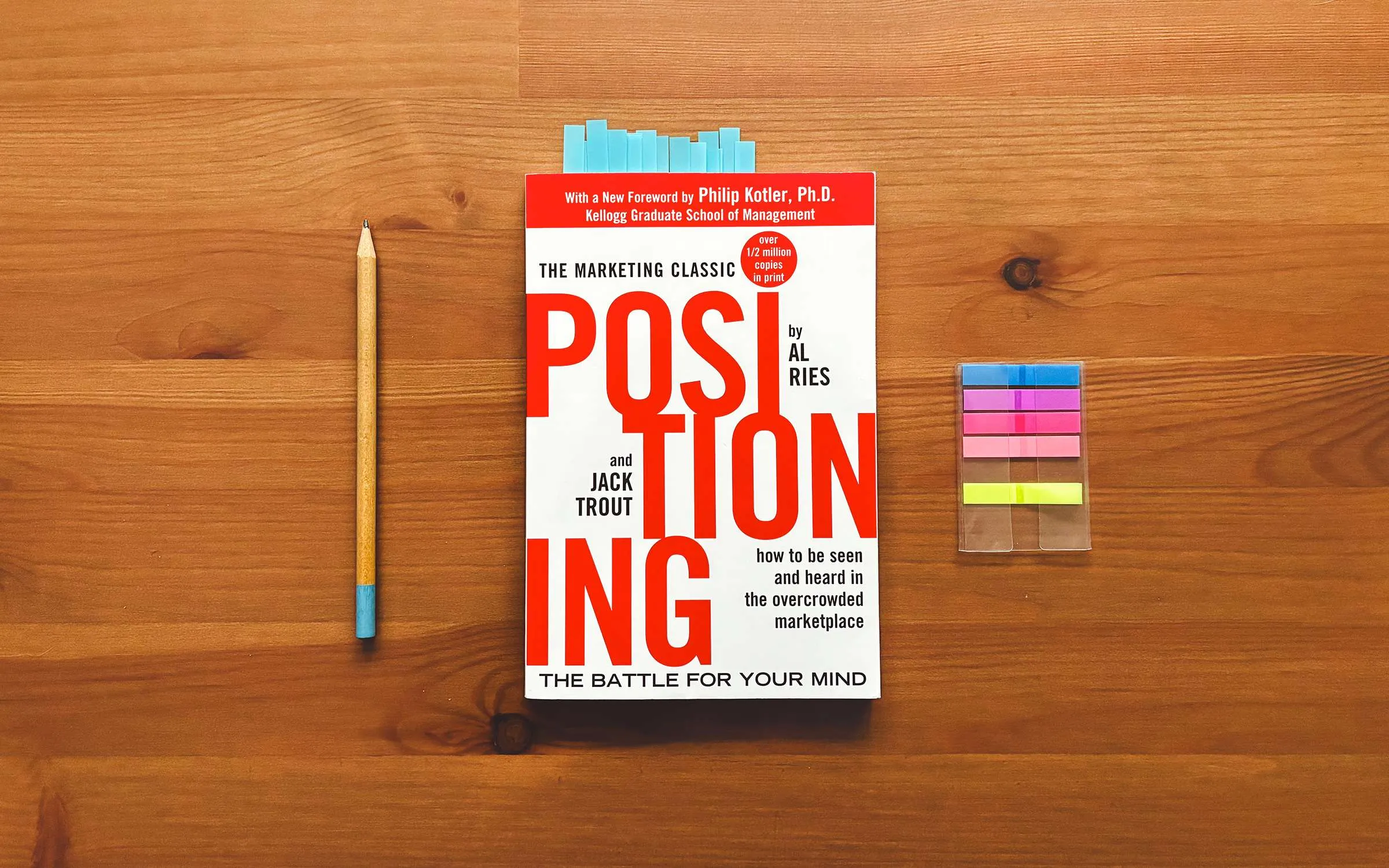
Positioning
The Battle for Your Mind
Al Ries; Jack Trout
- What it's about
- Ries and Trout wrote Positioning for a world where marketing was getting louder, not clearer. More products. More media. More “me too” brands. The average buyer has limited attention, so the mind protects itself by filtering most messages…
- Why read it next
Ries and Trout’s classic is the natural next step after $100M Offers: once you’ve engineered an offer that is genuinely more valuable than the alternatives, you still have to claim a clear, simple place for it in the prospect’s mind.
It’s a strong follow-up because Hormozi teaches you how to build the thing, and Positioning teaches you how to make sure the right people remember what it is and why it matters.