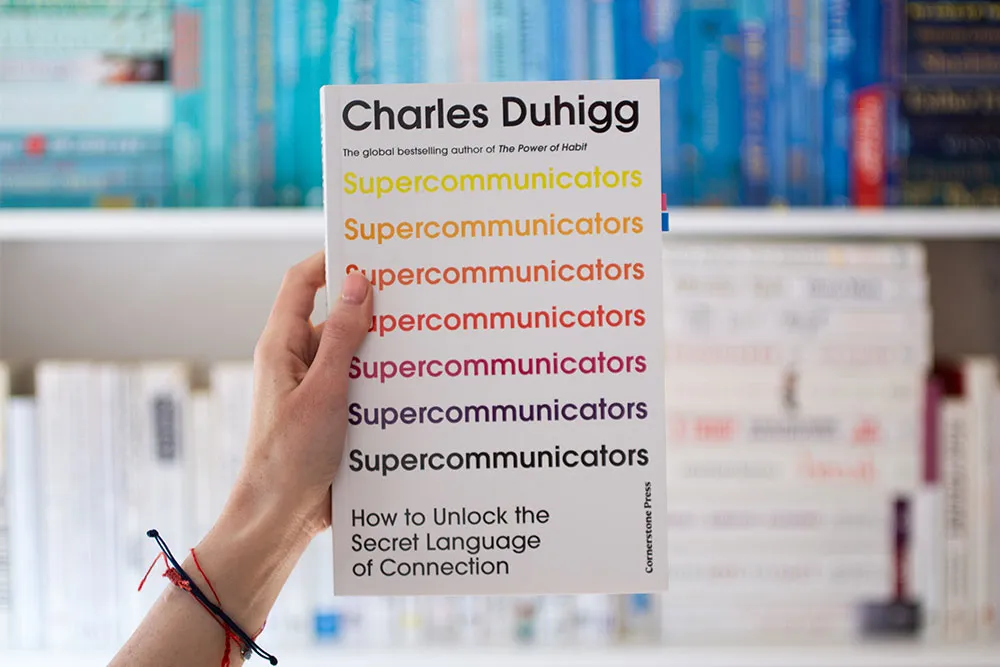
Why this book exists
Charles Duhigg wrote Supercommunicators because he kept running into the same private frustration that most of us recognise: he could be articulate, well-prepared, and well-intentioned, and still walk out of important conversations — with his wife, his colleagues, his kids — feeling unheard or misunderstood. As a journalist, he started asking why some people consistently make others feel deeply understood, while equally smart people leave a trail of awkward, sticky, or strained interactions behind them.
The book's promise is unusually optimistic for the genre: connection is not a personality trait. It is a learnable skill, built on a small set of habits anyone can practise. Duhigg is essentially fighting the idea that some people are "just good with others" and the rest of us are stuck.
Who Charles Duhigg is (and why it matters)
Duhigg is a Pulitzer Prize–winning investigative journalist, a long-time staff writer at The New Yorker and The New York Times, and the author of two earlier blockbusters: The Power of Habit and Smarter Faster Better. His signature move across all three books is the same: take a slippery human topic (habits, productivity, now communication), find the underlying research, and braid it together with vivid stories from people whose lives or jobs depend on getting it right.
That track record matters here for two reasons. First, the book is genuinely research-grounded — neuroscience, linguistics, social psychology, negotiation studies — not opinion dressed up with anecdotes. Second, Duhigg is openly writing as a fellow struggler. He uses his own communication failures, including a recurring fight with his wife, as the spine of the book. That honesty buys him a lot of credibility before the framework even arrives.
The thesis in one sentence
Every conversation is actually one of three different kinds happening at once, and the people we experience as "supercommunicators" are simply those who quickly recognise which kind is in the room — and match it.
The deeper problem the book is really addressing
Underneath the practical advice, Supercommunicators is pushing back on three assumptions most of us carry:
- That we are all having the same conversation. Two people can be face to face, using the same words, and be in completely different conversations in their heads. One wants to solve a problem; the other wants to feel less alone. The misfire is not about content — it is about type.
- That logic should win. Many of us were taught that good communication means clear facts, clean arguments, and rational persuasion. Duhigg's research shows that emotional and identity-level conversations are not detours from the "real" conversation — they often are the real conversation, and treating them as noise is exactly how connection breaks.
- That connection is innate. The book's most encouraging argument is that supercommunicators are not born; they are made through a small repertoire of habits, most of which feel almost embarrassingly simple once you see them. The fix is not to talk more or talk less. It is to learn to listen for which conversation is actually happening and respond in kind.
How the book works: the three conversations
The spine of Supercommunicators is the idea that almost every meaningful conversation is one (or a mix) of three types:
- Practical conversations — "What's this really about?" These are about decisions, plans, problems, and solutions. The implicit question is what should we do?
- Emotional conversations — "How do we feel?" These are about experiences, fears, hopes, frustrations, and grief. The implicit question is what do we need from each other right now?
- Social conversations — "Who are we?" These are about identity, belonging, relationships, and the groups we see ourselves as part of. The implicit question is how do we relate to one another and the world? The core insight is the matching principle: conversations go well when the people in them are in the same kind of conversation, and they go badly when they are not. If your colleague is in an emotional conversation and you respond with a practical fix, you will both leave frustrated — even though, on paper, you were "helpful".
Supercommunicators do three things almost unconsciously: they notice which conversation is happening, they signal which one they are in, and they invite the other person to either join them or pull them into a different one.
Practical ideas you can actually use
Ask what kind of conversation this is — out loud if needed
The single highest-leverage move in the book is also the simplest: at the start of an important conversation, ask some version of "Do you want to vent, or do you want help thinking this through?" This is not a trick — it is an act of respect. It tells the other person you are willing to be in their conversation, not the one you assumed you were having.
In meetings, the same move sounds more like: "Are we trying to make a decision here, or are we still exploring how people feel about this?"
Ask deep questions, not just data questions
Duhigg distinguishes between shallow questions (facts, logistics, what someone does for a living) and deep questions (values, beliefs, experiences, what something means to a person). Deep questions sound risky but rarely are — most people are quietly relieved to be asked them.
Examples that recur in the book:
- What drew you to this work in the first place?
- What's something you've changed your mind about in the last year?
- When did you first realise this mattered to you?
- What's the part of this you don't usually get to talk about? A deep question, asked with genuine curiosity, almost always shifts a conversation from practical to emotional or social — which is often exactly where the real conversation has been waiting.
Loop for understanding
One of the book's most quietly powerful tools is looping for understanding, a technique adapted from professional mediators. It has three steps:
- Ask a question, usually a deep one.
- Repeat back what you heard, in your own words.
- Ask if you got it right. That third step is the magic. It signals that you care more about understanding than about being right, and it gives the other person a chance to correct you before the conversation runs off the rails. In Duhigg's stories, looping repeatedly turns hostile or stuck conversations into productive ones.
Prove you are listening, don't just listen
In one of the book's most-cited findings, researchers showed that what makes people feel heard is not silent attention but visible engagement: leaning in, asking follow-ups, reflecting back, naming emotions, sharing small pieces of yourself in return. Listening is a performance in the honest sense of the word — it has to be visible to count.
Practical cues: paraphrase before you respond; name the emotion you think you're hearing ("that sounds really frustrating"); resist the urge to immediately one-up the story with your own.
Match emotion with emotion (not with logic)
When someone is in an emotional conversation, the worst response is usually advice. The best is usually some version of acknowledgement before action: name what they're feeling, share that you've felt something similar, and only then — if they want — move toward problem-solving. Empathy is not a soft skill bolted onto the conversation; in emotional conversations, it is the conversation.
Make identity safe in hard conversations
For social or identity-laden conversations — politics, race, religion, values — Duhigg leans on research showing that progress only happens when people don't feel their identity is on trial. Two practical moves:
- Acknowledge the parts of the other person's view that make sense before you challenge any of it.
- Speak from your own experience rather than from abstract positions. "Here's what shaped how I see this" lands very differently from "Here's why you're wrong."
Notice the conversation underneath the words
A lot of conflict, especially in close relationships, is two people having two different conversations at once: one person is in a practical conversation about the dishes, the other is in a social conversation about respect. The fight isn't really about the dishes — it's about the mismatch. The way out is almost never winning the surface argument; it is naming the underlying conversation and choosing to enter it together.
Essential narratives (the kind that teach)
Duhigg builds the book around several long, vivid case studies. The four that do most of the teaching:
- The CIA recruiter. A veteran intelligence officer who can turn cold contacts into trusted sources within hours, not because of charisma but because she relentlessly asks deep questions and loops back what she hears. The lesson: trust is built faster by curiosity than by charm.
- The jury deliberation room. A reconstruction of a contentious murder trial where the jurors are stuck until one of them stops arguing the facts and starts asking the others how they came to see the case the way they do. The deadlock breaks once the conversation shifts from practical to social. The lesson: when persuasion stalls, change the type of conversation, not the volume.
- The NASA team behind a tense mission. Engineers and astronauts who have to navigate disagreement under extreme pressure. The teams that perform best are not the ones with the smartest individuals; they are the ones with the strongest matching habits — checking emotional state, surfacing assumptions, looping. The lesson: in high-stakes teamwork, communication quality outperforms individual brilliance.
- The doctor and the patient. A series of medical conversations where the difference between a patient feeling cared for and feeling processed comes down to whether the clinician asks one or two deep questions and reflects back what they hear. The lesson: even thirty seconds of the right kind of conversation can change the outcome of the whole interaction.
- Duhigg's marriage. The quiet through-line of the book. He keeps coming back to a fight he and his wife have over and over again, and uses each new tool he learns to try to do it better. By the end, the fight hasn't disappeared — but it has changed shape, and that change is the proof of concept.
Notes, critiques, and caveats
- The framework can feel tidier than reality. Real conversations are messy and often shift between practical, emotional, and social modes mid-sentence. Some reviewers argue that the three-conversation model, while useful as a lens, can flatten the complexity of how people actually talk. The fair response is that it's a starting point, not a complete map.
- Heavy on anecdote, lighter on rigor in places. Like The Power of Habit, the book leans on dramatic case studies to illustrate research. Critics point out that some of the stories are stylised and that the link between specific studies and specific advice is occasionally looser than it sounds on the page. The principles are well-supported overall, but readers should treat individual stories as illustrations, not proofs.
- Risk of mechanising conversation. Used clumsily, the tools (loop for understanding, match emotion, ask deep questions) can come across as performative or therapised. The book's spirit is that these habits should become second nature, not visible scaffolding. If your partner notices you're "using a technique," you've probably gone too far.
- Mostly a Western, professional-class lens. Many of the examples come from US workplaces, courtrooms, and intimate relationships in a fairly specific cultural register. The core ideas travel well, but specific phrasings and norms (around directness, emotional disclosure, deep questions with strangers) will need calibration in other cultures.
- Doesn't solve power imbalances. The matching principle assumes both parties are willing, in some basic way, to engage. In conversations with manipulative, abusive, or deeply bad-faith counterparts, the techniques will only take you so far — and Duhigg is more cautious than emphatic about that limit.
Who this book is for (and who it isn't)
Read it if you:
-
Have an important relationship — at work or at home — where you keep having the same frustrating conversation.
-
Lead a team and want a shared language for why some meetings and 1:1s land and others don't.
-
Work in any role where trust has to be built fast: sales, recovery, therapy, coaching, journalism, healthcare, recruiting, diplomacy.
-
Are an introvert or self-described "bad at small talk" person who suspects you'd connect more easily with a clearer model.
-
Loved The Power of Habit and want Duhigg's same approach applied to the most human of subjects. It may not be the right book if you:
-
Want a deep, academic treatment of communication theory; this is a popular non-fiction book first, a research synthesis second.
-
Are looking for a quick tactical playbook for specific situations (difficult feedback, negotiation, conflict resolution). The principles apply, but you'll have to do the translation.
-
Are already deep into the work of Brené Brown, Kerry Patterson (Crucial Conversations), Chris Voss, or Marshall Rosenberg. Much of Supercommunicators will feel like a fresh, well-told remix rather than entirely new ground.
Resources
What to Read Next
Summary · 5 min read
Dare To Lead
Brené Brown
- What it's about
- Dare to Lead exists because many organisations say they want “leaders,” but reward self-protection: pretending to know, avoiding hard conversations, managing perception, and staying safe. Brené Brown argues that this creates cultures of…
- Why read it next
Brené Brown's research-backed playbook for courageous leadership, built around rumbling with vulnerability, living into values, and building trust through specific, observable behaviours. It's the natural next read because Supercommunicators teaches you how to recognise and match the kind of conversation you're in, while Dare to Lead gives you the courage, language, and inner work to actually stay in the room when those conversations get hard.