When effort stops being the answer
High performers learn an early lesson: work hard, stay disciplined, and results will follow. That formula can carry someone through school, sport, and the first stages of a career or business. Then a season arrives when the same effort produces less progress. Working harder becomes exhausting rather than effective.
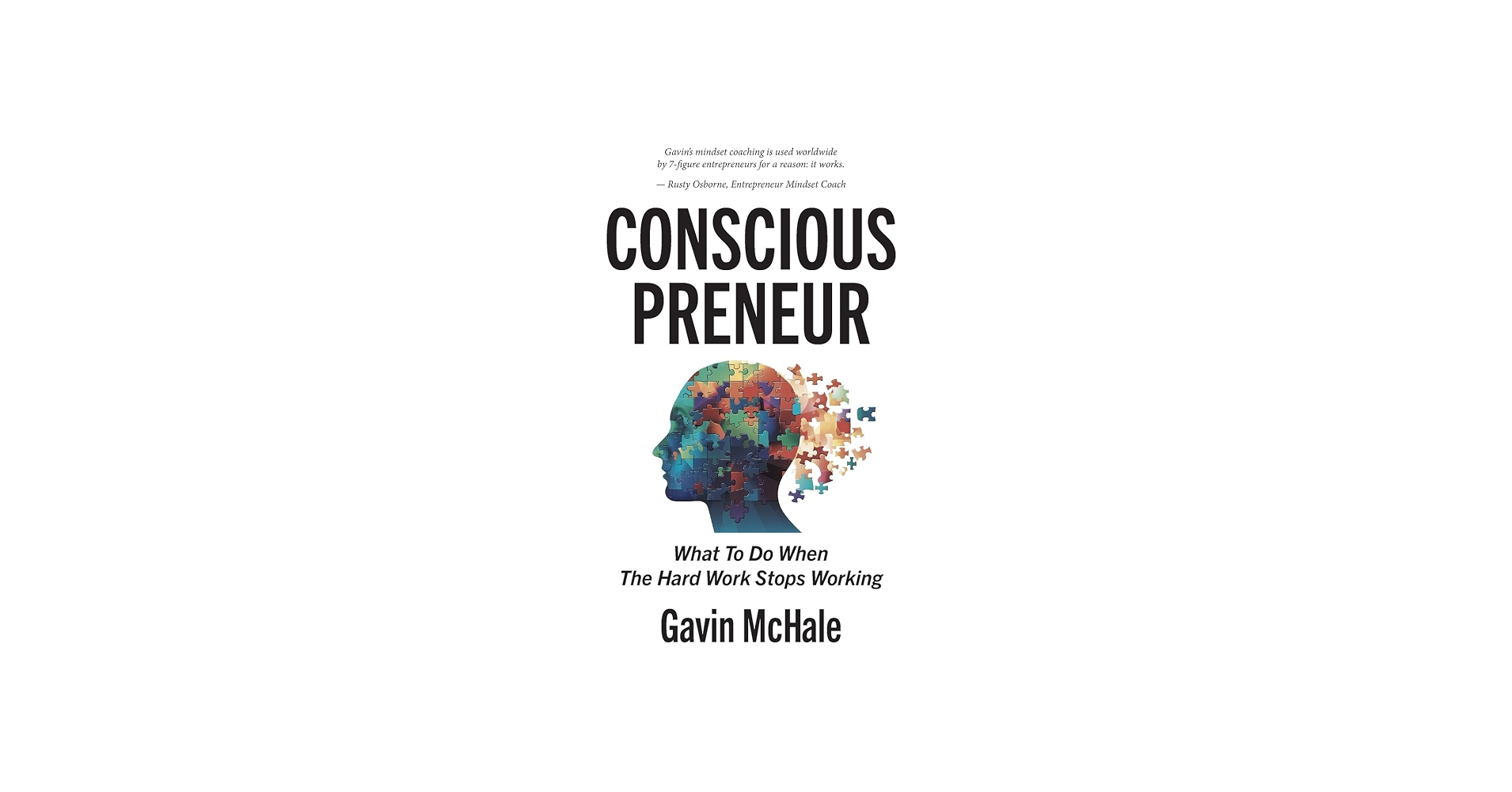
Consciouspreneur: What to Do When the Hard Work Stops Working is written for that moment. Gavin McHale argues that the obstacle is often not a missing tactic. It is an unseen pattern of belief, emotion, identity, and self-protection shaping how the person uses every tactic.
Published by FriesenPress in 2024, the book blends memoir, personal development, performance coaching, and entrepreneurship. It is aimed at founders, coaches, athletes, and ambitious people who are outwardly capable but repeatedly undermine their own progress.
Its purpose is to move the reader from unconscious performance to conscious growth: seeing the stories behind behaviour, learning to respond differently to failure, and building success without making achievement the sole source of identity.
The coach behind the message
Gavin McHale is a personal development coach and former major junior hockey player. He has worked with business owners and elite athletes on performance, mindset, and personal growth.
His credibility comes less from academic status than from lived failure. McHale was used to winning in hockey and school. When his professional hockey path stalled, hard work no longer protected his identity. He later carried similar patterns into a personal-training business, where negative self-talk and self-sabotage limited the very actions needed for growth.
That experience shapes the book’s tone. McHale is not arguing that effort is unimportant. He is explaining why disciplined people can remain stuck when their effort is driven by fear, old stories, emotional avoidance, or a need to prove their worth.
The central claim in one sentence
When hard work stops producing growth, the next breakthrough comes from making unconscious beliefs, emotions, and identity patterns visible—then choosing actions from awareness rather than fear.
The hidden cost of being a high performer
Achievement can build confidence, but it can also create a fragile contract: “I am valuable when I win.” If winning has always been part of someone’s identity, failure becomes more than information about an attempt. It feels like evidence that the person is no longer enough.
This creates a trap. The high performer doubles down on familiar strategies because those strategies worked before. When they fail again, shame and negative self-talk intensify. The person may avoid difficult actions, perform them half-heartedly, or search endlessly for a new external method. The disappointing result then appears to confirm the original belief.
The deeper problem is not laziness. It is an unconscious protection system. Avoidance protects the person from rejection in the short term, while quietly guaranteeing stagnation in the long term.
McHale’s response is to turn inward. The goal is to see the belief driving the behaviour, regulate the emotion attached to it, and choose a more useful story and action.
From vicious cycles to conscious action
The book’s practical logic can be understood as a repeating loop. Beliefs shape interpretation. Interpretation creates emotion. Emotion influences action or avoidance. Results then reinforce the original belief.
See the story
Start with the language running beneath the problem: “This won’t work for me,” “I should already know this,” “If I fail, people will see I’m not good enough,” or “I need another qualification before I begin.”
These statements often feel like objective facts. McHale asks the reader to treat them as stories—learned explanations that may once have protected a sense of identity but are now limiting behaviour.
Name the emotion
A story gains power because it is tied to emotion. Fear of judgment can look like perfectionism. Shame can look like procrastination. Anger can hide helplessness. Restlessness can look like ambition while preventing sustained attention.
Becoming conscious means recognising the feeling without immediately obeying it. The aim is not to suppress emotion or “stay positive.” It is to understand what the emotion is trying to protect.
Find the protective behaviour
The next step is to identify what happens because of the story and emotion. Do you delay publishing, avoid sales conversations, overprepare, keep changing offers, micromanage the team, or abandon a strategy before it has enough time to work?
This is where self-awareness becomes practical. A limiting belief matters because it changes behaviour. Naming the specific behaviour creates something that can be tested and changed.
Rewrite the meaning of failure
McHale’s athletic story makes failure central to the book. When identity depends on being naturally successful, failure becomes threatening. Conscious growth treats failure as feedback: information about skill, strategy, preparation, timing, or fit.
This does not make failure pleasant. It makes it usable. The question shifts from “What does this say about me?” to “What is this showing me, and what will I practise next?”
Take a different action
Insight alone does not break a loop. The new belief has to be paired with a visible behaviour: make the call, publish the work, ask for feedback, keep the promise, rest before exhaustion, or stay with a strategy long enough to learn from it.
A small action creates new evidence. New evidence makes a more constructive belief easier to trust. Repetition gradually turns a vicious cycle into a virtuous one.
What conscious entrepreneurship changes
The word “consciouspreneur” points beyond mindset techniques. It asks what kind of person someone is becoming while building a business.
Success becomes broader than revenue
Revenue matters. A business must work economically. But money alone cannot answer whether the work is aligned, sustainable, or worth the personal cost.
A conscious entrepreneur considers performance alongside health, relationships, purpose, emotional maturity, and the quality of daily life. This is not a rejection of ambition. It is an attempt to keep ambition from consuming everything it was meant to support.
Identity becomes more flexible
A founder can become fused with the business. A bad month feels like a personal failure; feedback feels like rejection; delegation feels like losing importance. McHale’s approach encourages a wider identity: you are the person building the business, not the business itself.
That separation makes it easier to receive information, change direction, and make decisions based on reality rather than ego protection.
Inner work becomes part of execution
In conventional business advice, emotions and beliefs are treated as private matters. In practice, they show up in pricing, hiring, conflict, marketing, leadership, and risk.
Inner work is therefore not separate from strategy. If fear prevents a founder from selling, a better sales script will not be enough. If the need for control blocks delegation, a new org chart will not solve the problem. The person and the business form one system.
Recovery becomes a performance skill
Relentless effort can look admirable while degrading judgment. A conscious approach pays attention to energy, emotion, and capacity before burnout turns them into business problems.
Rest is not a prize earned after success. It is part of the system that makes clear thought and sustained contribution possible.
A practical reflection cycle
When you notice that effort is no longer working, pause before adding more effort.
Ask:
- What result keeps repeating? Describe the pattern without drama.
- What story do I tell myself about it? Write the exact sentence.
- What emotion sits underneath that story? Name it plainly.
- What does that emotion lead me to do or avoid? Look for observable behaviour.
- What is the story trying to protect? Approval, certainty, status, competence, belonging, or control?
- What else could the result mean? Create an explanation that is both kinder and more accurate.
- What small action would produce new evidence? Choose something concrete and time-bound. Then review the result with curiosity. The goal is not to prove that the new story is true immediately. It is to stop allowing an old story to decide the outcome without being tested.
The experiences that make the lesson real
Hockey and the identity of a winner
McHale grew up performing well in sport and school. Hockey reinforced the belief that hard work and talent would keep producing success. When his professional path faltered, the loss was not only vocational. It threatened the identity he had relied on.
The lesson is that strengths can become traps when identity depends on them. A person who only knows how to win may be less prepared to learn from losing.
Repeating the pattern in business
After hockey, McHale moved into personal training and entrepreneurship. He worked hard but found himself repeating forms of self-sabotage. External effort could not overcome the internal expectation that certain actions would fail.
The lesson is that changing environments does not automatically change the patterns we carry into them.
The half-hearted action loop
One of the most useful business patterns in the book is acting without belief. A person expects a marketing effort to fail, gives it limited energy, stops early, and then uses the weak result as proof that the strategy never worked.
The lesson is not “believe harder.” It is to separate the test from the identity, define what a fair attempt looks like, and collect better evidence before drawing a conclusion.
Turning inward
McHale’s larger shift comes when he stops looking only for new external answers and examines the beliefs beneath his behaviour. That move does not replace hard work. It changes the source and direction of the work.
The lesson is that sustainable performance requires self-knowledge as well as discipline.
Where the argument needs care
The book’s main limitation is its evidence base. It is a coach’s synthesis of personal experience, client work, and accessible research rather than a comprehensive scientific review. The stories can illuminate patterns, but they cannot prove that a particular inner intervention will produce the same result for everyone.
A second caveat is the risk of over-internalising failure. Beliefs and behaviour matter, but founders also face weak demand, poor timing, limited capital, discrimination, market concentration, and plain bad luck. Not every stalled business is a mindset problem. Turning inward should complement honest market and strategic analysis, not replace it.
Third, “limiting belief” can become a label for realistic caution. Fear sometimes carries useful information. A thoughtful response asks whether the concern is distorted, proportionate, or pointing to a genuine constraint. Growth is not the same as ignoring risk.
Fourth, identity work can become another performance project. High achievers may try to optimise every emotion, judge themselves for negative thoughts, or treat rest as a tactic for producing more. Consciousness should create more room for humanity, not a stricter inner manager.
Finally, the book is early in its public life and has a limited independent critical conversation around it. That makes it harder to assess how well its framework holds across cultures, industries, and people whose experience differs from the author’s. The best approach is to test its questions against your own behaviour while staying open to psychological, strategic, and structural explanations.
Who should read it
This book is for entrepreneurs, coaches, athletes, and high performers who know how to work hard but keep meeting the same internal barrier. It is especially relevant if business results have become tangled with self-worth, or if more tactics keep producing the same pattern.
It may not be the right book for someone needing a detailed operating system, financial strategy, or clinically grounded support for anxiety, trauma, or depression. Coaching ideas can be useful, but they are not a replacement for professional mental-health care when that is what the situation requires.
Resources
What to Read Next
Summary · 7 min read
Atomic Habits + The Atomic Habits Workbook
James Clear
- What it's about
- James Clear’s Atomic Habits exists for a very specific kind of frustration: you know what you “should” do, you even feel motivated sometimes, but your life doesn’t reliably change. You make big plans, then reality returns—stress…
- Why read it next
James Clear explains how repeated behaviour is shaped by cues, environment, identity, and small systems rather than motivation alone. The workbook side helps turn a desired identity into concrete habits and regular review.
It is a useful next read because Consciouspreneur helps expose the story beneath the behaviour, while Atomic Habits helps redesign the daily system that keeps the new behaviour going.